We’re the UK’s Go-To Cleaning Company
High-Standard Cleaning with Compassion and Care.
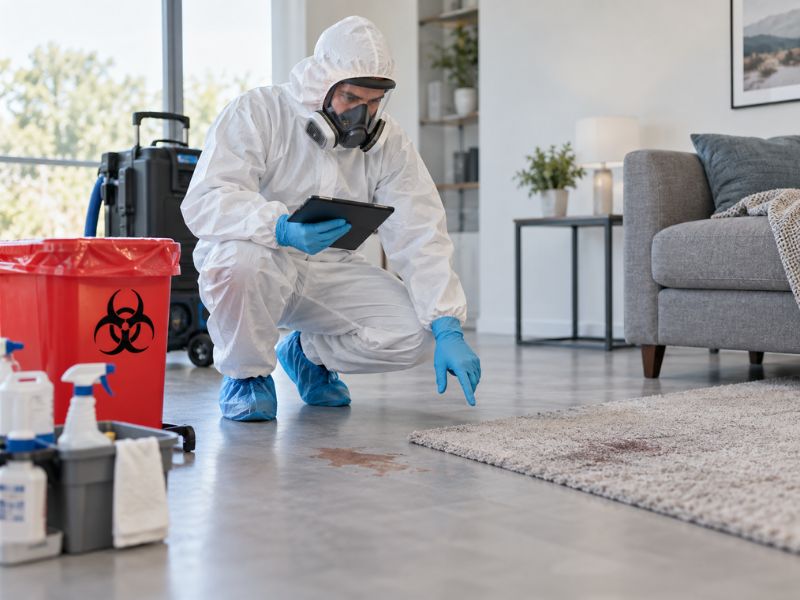
Most spills and stains in a home are just spills and stains. A bit of hot water, some disposable gloves, and a decent disinfectant will sort them out. But some incidents cross a line where ordinary cleaning stops being safe, and that's the point where professional biohazard cleaning takes over. Knowing where that line sits matters more than knowing every possible scenario, so that's what this article covers.
If the contamination is small, you know exactly what it is and where it came from, it's sitting on a hard, non-porous surface, and there's no reason to think it's linked to disease, injury, or a death, then careful household cleaning is usually fine. If it involves a death, a violent incident, a large or spreading amount of blood or bodily fluid, contamination that has soaked into carpet, fabric, or wood, discarded needles, or waste you can't put in a normal bin, that's when you need professional biohazard cleaning services. It isn't really about how big the mess looks. It's about whether a proper risk assessment would tell you to stop and bring in a biohazard cleaning company instead of finishing the job yourself.p
Not every blood spill means you're legally required to bring in a specialist company. The right response depends on the amount and type of contamination, how likely it is to carry infection, where it happened, what materials are affected, and whether you actually have the training and equipment to deal with it safely. That last part trips people up the most. Wearing gloves isn't the same as having a proper decontamination plan, and it isn't the same as having done a risk assessment.
A few signs tell you it's time to stop and call in professional biohazard cleaning rather than carry on:
If any of those apply, put the cloth down. Continuing past that point is where the real health risks start, and it's exactly the kind of situation biohazard cleaning services exist for. This is also where waste disposal starts to matter, since anything you've already touched may now need proper biohazard cleaning rather than a normal wipe-down.

Blood should be treated as potentially hazardous even when there's no obvious sign it's carrying anything harmful. You cannot tell whether blood is infectious just by looking at it, and UK health and safety guidance is built around that assumption rather than around guesswork. The same goes for other bodily fluids. Vomit, urine, faeces, sputum and wound drainage can all need controlled cleaning and disinfection, not just because they're unpleasant, but because bloodborne pathogens such as hepatitis B, hepatitis C and HIV can be present without any visible warning. Bloodborne pathogens are exactly why professional biohazard cleaning treats bodily fluids as biological substances that need containing, not just wiping away.
Biological contamination isn't limited to blood either. Biological agents can be carried in far smaller amounts of material than most people assume, and biological waste of any kind should be handled as if it's carrying something harmful until it's confirmed otherwise. Potentially infectious materials and contaminated materials both fall under the same rule: treat first, test never, because home testing isn't realistic. Bodily fluids can also carry biological agents responsible for infectious diseases such as norovirus, not just the bloodborne pathogens most people think of first. This is why any case of biohazard contamination gets treated the same way regardless of what caused it, whether that's a burst pipe of sewage or a single stain on a sofa.
Cleaning and disinfecting aren't the same job. Physical cleaning often has to happen first, because organic material like blood or tissue can stop a disinfectant from working properly. Skip that step, and you can end up with a surface that looks clean but hasn't actually been decontaminated. This is one reason DIY attempts at trauma cleaning tend to fall short, even when someone puts in a lot of effort. For anything following a serious accident, assault, or similar incident, it's worth understanding how trauma and crime scene cleaning actually works before attempting it yourself. Crime scenes in particular need this two-step approach, since spatter and pooling from violent crime scenes often reach further than they appear to. Full biohazard decontamination only counts as finished once both steps, cleaning and disinfecting, have been carried out properly across the whole area, not just the parts that were easy to reach.
For context on how often these situations arise, official statistics recorded 522 homicide victims in England and Wales in the year ending March 2025, and an estimated 9.6 million incidents of crime overall in the year ending March 2026, with violence making up a large share of that total. After a death or a serious violent incident, specialist trauma cleaning is often needed once the police and other authorities have finished their work at the property, and crime scenes are handed back to owners far more often than most people realise.
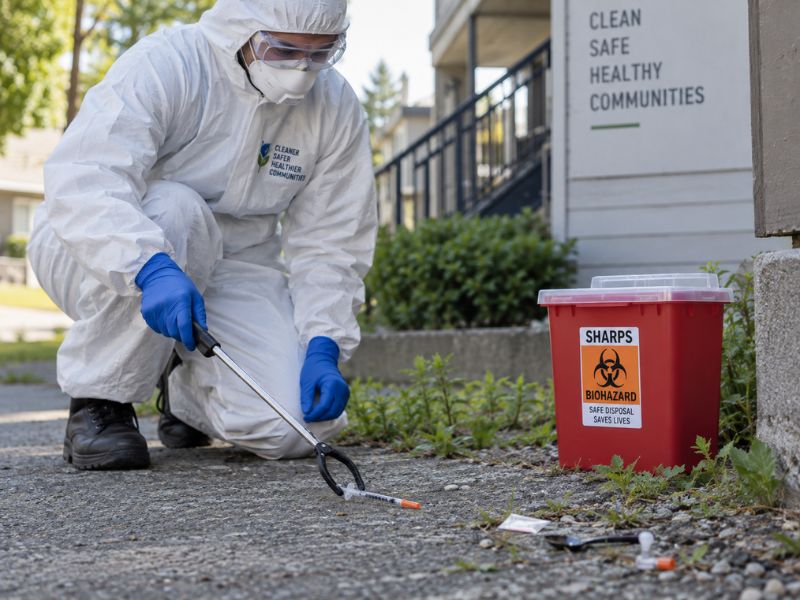
Finding a discarded needle changes the calculation completely. HSE guidance identifies contaminated sharps as a real route of exposure to bloodborne pathogens, which is why a needle should never be treated like ordinary litter. Picking one up with a tissue or a gloved hand, without the right training and disposal equipment, can lead to a needlestick injury. That single moment is enough to expose someone to serious health risks, and it's the kind of situation where trained professionals earn their fee.
This applies just as much to other drug paraphernalia found alongside needles, since these items are often contaminated in ways that aren't visible. If you've found sharps or related waste on your property, a proper needle sweep covers the licensed routes needles have to go through once they're collected, and it's a job for a biohazard cleanup team rather than a bin bag and a dustpan. This is one of the more common reasons people search for biohazard cleaning in the first place, and it's a straightforward biohazard cleanup once someone qualified is on site.
Smell is one of the clearest warning signs there is, and one of the easiest to ignore. A smell that doesn't shift after normal cleaning, flies or other insects appearing from nowhere, and staining that spreads wider than the original area are all signs that contamination has gone further than what you can see. This is common after an unattended death, where bodily fluids can work their way into flooring, furniture, mattresses, and even subfloor materials well before anyone realises something is wrong. Unattended deaths are also one of the clearest examples of when professional biohazard cleaning stops being optional. Once bodily fluids have reached this stage, biohazard cleaning is rarely a same-day job, since the source has to be traced before anything can be properly sealed off.
Reaching for air freshener or a strong-smelling cleaning spray might hide the problem for a day or two, but it doesn't remove the source. Meanwhile, the contamination keeps spreading and gets harder to deal with the longer it's left. If you're dealing with an unattended death or a property that's been left unoccupied with these signs present, after-death cleaning is built for exactly that, including how affected materials are assessed and removed where needed. The same warning signs show up at some crime scenes and at industrial accidents, where chemical spills can sit alongside biological hazards and make the smell even harder to read correctly.
Carpet, underlay, mattresses, upholstered furniture, grout, and untreated wood all soak up liquid rather than sitting on top of it. Once a fluid has worked its way into one of these materials, wiping the surface doesn't remove what's underneath. That's the part people miss most often. The risk can remain even after all visible contamination has disappeared, because cleaning the top layer never touched what soaked in below it.
In a lot of cases, the only safe option is removing the affected material rather than trying to clean it in place. That waste then has to be handled as biohazardous waste rather than ordinary rubbish. Contaminated carpet, PPE, absorbent materials, and sharps count as biohazardous materials, and biohazardous materials generally can't go in a normal household bin. Depending on what's involved, this can mean clinical waste, medical waste, animal waste, or, in rarer cases, human or animal waste mixed together, and each category has its own handling rule. None of it belongs in a general biohazard waste bag from under the sink either. Hazardous waste produced during a job like this has to be bagged, labelled, and collected by licensed waste carriers under UK hazardous waste rules, including duties that trace back to the Environmental Protection Act. Proper disposal isn't optional, and waste disposal on a job like this has to follow the same paper trail every time so it can be signed off properly.
A single visit can produce several separate categories of biohazardous waste, from soaked underlay to used PPE, and biohazardous materials from different rooms usually can't be mixed together even temporarily. Coordinating biohazardous waste collection alongside biohazardous materials storage on site is a big part of why this work needs planning, not just a strong stomach, and the route for both has to be arranged before cleaning even starts. Get the waste disposal and waste management side wrong and even a well-executed biohazard cleaning job, or a fast biohazard cleanup, can leave biohazardous waste sitting on site for days, with biohazardous materials from biological agents in the mix having nowhere approved to go. Skipping that step isn't just a compliance issue. It leaves a genuine health risk sitting in your general waste.
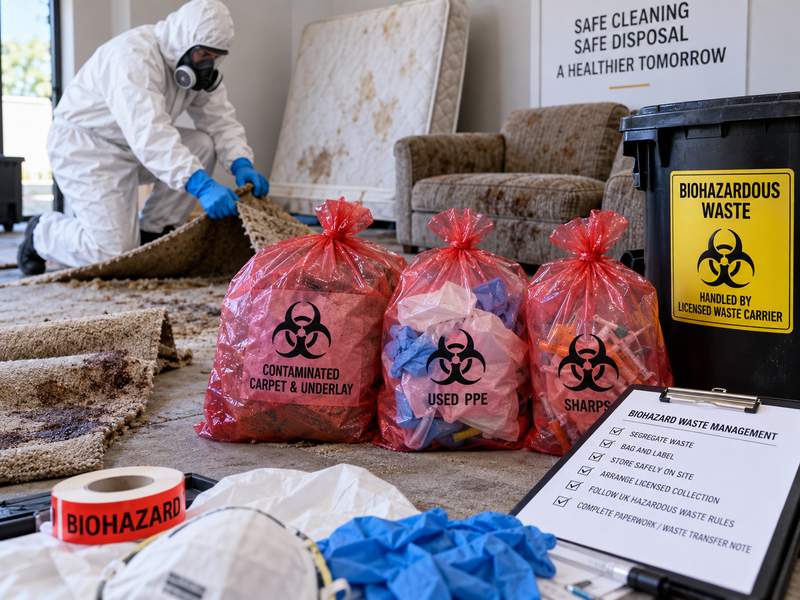
Children, pets, elderly people and anyone with a weakened immune system should be kept well away from a contaminated area until it's been properly dealt with. So should anyone without full personal protective equipment PPE cover, since PPE isn't just gloves. Depending on the situation, it can include a mask, eye protection, overalls and proper footwear, all meeting UK safety standards rather than whatever happens to be in a kitchen drawer. Personal protective equipment matters just as much for a small domestic job as it does for a large commercial one, and a proper personal protective equipment PPE checklist should be run through before anyone steps into the affected room.
This isn't only a household concern. Employers have a legal duty under the Control of Substances Hazardous to Health Regulations, generally known as COSHH, to assess the risk when staff might come into contact with biological hazards and hazardous biological substances, and to put suitable control measures in place. A proper risk assessment under COSHH looks at hazardous substances, hazardous materials, and general health hazards together, rather than treating each one in isolation. Health and safety regulations in this area are enforced by the Health and Safety Executive, and a written health and safety plan is a sensible step for any workplace where biological hazards could reasonably turn up.
That applies to cleaners, caretakers, office staff, and anyone else who might reasonably walk into an affected area. Getting this wrong isn't just a health risk. It can also pose significant health risks to untrained staff and lead to serious fines for the business responsible, since worker safety under safety regulations isn't something an employer can quietly skip. UK health regulations and wider health and safety expectations both point the same way here: assess first, protect people, then clean. Health regulations don't distinguish much between a large company and a single landlord in this respect.
A short list of who should stay clear until an area has been cleared:
Not every incident sits at the same level, and UK safe systems of work tend to reflect that. A small, contained spill on a hard surface might be one that requires basic safety precautions, little more than gloves, a suitable disinfectant and careful disposal. A larger domestic incident often requires enhanced safety precautions, with fuller PPE and a proper risk assessment before anyone starts, and this is usually where a general professional cleaning team hands the job over to a specialist one. Commercial premises, industrial accidents, or anything involving unknown substances hazardous to health, including biological substances and biological agents, usually require advanced safety precautions, closer to what you'd expect from biohazard cleanup companies rather than a single technician. At the top end, incidents such as large-scale trauma, decomposition, or chemical spills combined with biological contamination can mean a job requires maximum safety precautions, involving full containment, air management, and strict safety protocols throughout.
This kind of tiering matters because basic safety precautions on a job that actually needed advanced safety precautions is how people get hurt. Maximum safety precautions might look excessive from the outside, but biohazard cleanup teams apply them because the control of substances hazardous to health has to match the real risk, not the risk it looks like from the doorway. Appropriate safety measures, sound waste management protocols and strict safety protocols aren't box-ticking. They're what stops harmful bacteria and infectious diseases from becoming a second incident on top of the first one, and they're why waste management sits right at the centre of every tier, not just the largest jobs.
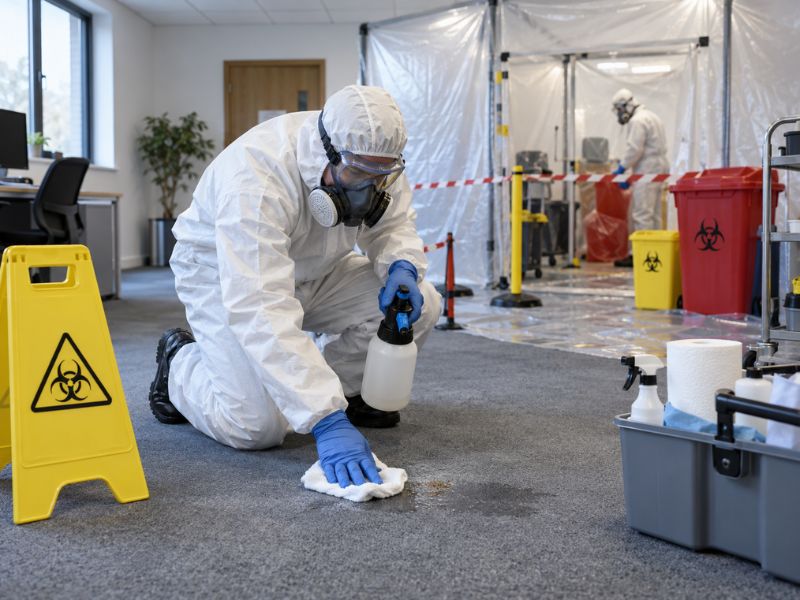
A good specialist cleaning company will ask more questions than you expect, and that's a good sign, not a delay. Be ready to explain what happened, roughly when it happened, and what type of contamination is involved. Say whether it's a home, a rented property, or a workplace, how large the affected area is, and which materials seem to be involved, such as carpet, furniture, or subfloor. Mention if there are needles or other sharps present, whether anyone vulnerable has been near the area, and whether your landlord, letting agent, or insurer needs to be told. This is the point where biohazard cleaning professionals turn a stressful situation into a straightforward job, rather than one you're guessing your way through.
Most professional cleaning companies offering biohazard cleaning services will also ask whether this is a one-off incident or something that has built up over time, since that changes whether the job is closer to specialist cleaning or professional deep cleaning. Reputable biohazard cleaning services scope every job individually rather than quoting blind. A genuine professional biohazard cleanup is not the same thing as a deep cleaning visit, even though the two get confused often. Deep cleaning addresses dirt and grime. Professional biohazard cleaning addresses risk, and that distinction is worth explaining to the company you call so they scope the job correctly from the start.
On cost, current UK pricing for biohazard cleaning and trauma cleaning, including labour, personal protective equipment and disposal, tends to fall somewhere between around £250 for a small, contained incident and £3,500 or more for extensive contamination, with unattended deaths and larger trauma scenes generally sitting at the higher end of that range. Biohazard cleaning costs in Liverpool generally follow this same UK-wide range, though local providers may vary slightly depending on demand and travel distance. This is a rough guide only, and the actual cost will depend on the size of the job, how many rooms or materials are affected, how quickly you need someone on site, and what has to be disposed of as hazardous waste. A proper quote always needs to be based on your specific situation rather than a number from an article.
The decision threshold comes down to one question. Can you identify the risk, and can you control it safely with what you have at home? If yes, clean it yourself with proper gloves and a suitable disinfectant. If no, because the contamination is linked to a death, violence, sharps, an unknown source, or materials that have soaked it in, that's the point where professional biohazard cleaning needs to take over from a general biohazard cleanup attempt at home. Getting that call right protects your health, and it's usually a lot cheaper than dealing with a problem that's been left to spread. At Scrubbed With Love, working out where that line sits, running the risk assessment, and matching the response to it is the kind of judgment call we help people make every week, without the guesswork. Whether it's a single stain or a whole room of biohazardous waste and biohazardous materials, that's what biohazard cleaning is actually for, and it's why biohazard cleaning is worth calling in the moment you're unsure rather than after the damage has spread.