We’re the UK’s Go-To Cleaning Company
High-Standard Cleaning with Compassion and Care.
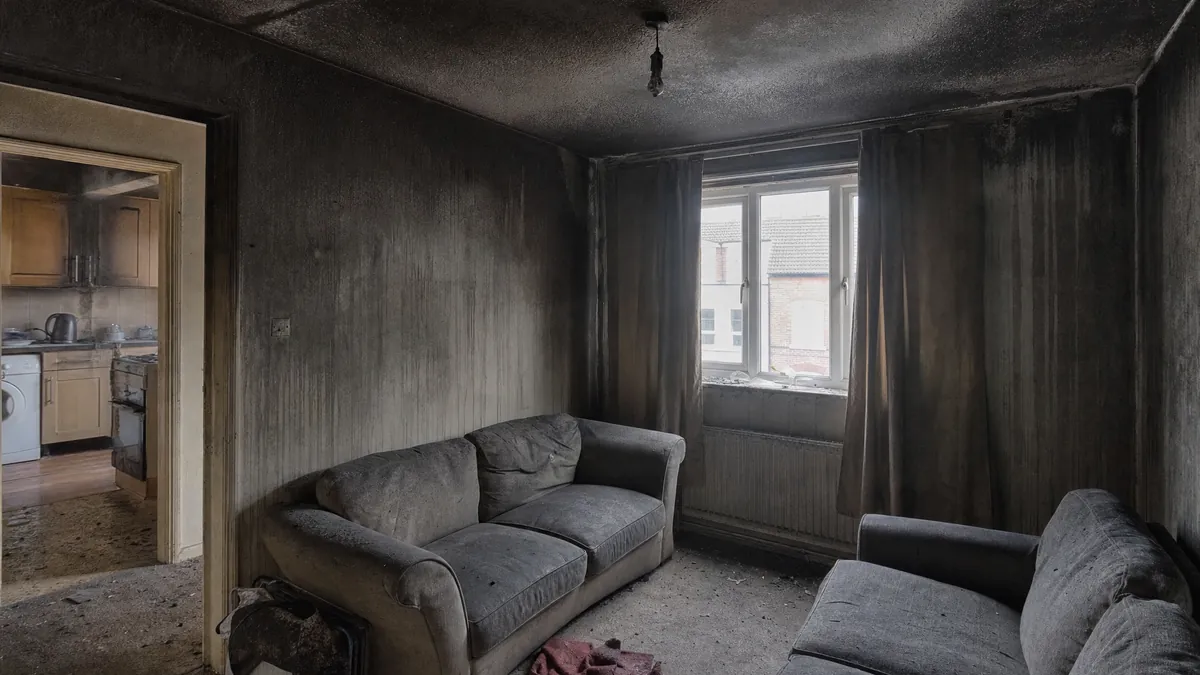
Do not start cleaning after a fire until the fire service says the building is safe to enter, the air has been checked and anyone at higher risk has left. Soot is made of fine particles. Wipe it, sweep it or vacuum it the wrong way and those particles go into the air. They can penetrate deep into your lungs, so a quick tidy-up can lead to serious health issues.
If you get a sore throat, chest pain or difficulty breathing after a fire, speak to a doctor immediately. If the symptoms are severe, call 999. Smoke and soot can adversely affect your body within hours, and some of the harm only shows up years later.
We are Scrubbed With Love, and we clean up after fires. The biggest mistake we see is people rushing in with a mop and a bucket. Below, we explain the health risks, the exact moments to stand back, and what to do first instead.
Smoke and soot travel together after a fire, but they are not the same thing. Smoke is a cloud of gases, tiny solid bits and liquid droplets. Soot is the black, powdery part that settles on walls, ceilings and belongings. Smoke and soot are complex mixtures, and what sits in them depends on what burned.
A wood fire gives off one set of chemical compounds. A fire that burns plastic, foam, paint or carpet gives off a wide array of others. Modern homes are full of synthetic building materials and furnishings, so the smoke from a house fire is rarely simple. Many of those chemicals are toxic. Some of the chemical compounds in smoke are linked to cancer, and toxic residue from burned building materials can stay on surfaces for months. That is why a room that looks like a bit of dirt can still be dangerous. Exposure to smoke and soot poses severe hazards to human health, even after a small fire. These health hazards do not fade when the flames go out. Serious health issues can follow a fire that seemed small, because the risk sits in the air and on the surfaces, not just in the flames. Each of these chemical compounds is a reason to take the clean up slowly. Smoke and soot are a health problem first and a cleaning problem second.
Soot comes from burning that goes wrong. When materials burn cleanly, they turn mostly into carbon dioxide and water. Very little soot is left behind. For that to happen, the fire needs enough oxygen and a high heat.
A house fire rarely gets either. Furniture, carpets and building materials burn in a rush, and the room runs short of air. That is incomplete combustion. The same thing happens with incomplete burning of carbon based fuels such as wood, coal and oil. Organic materials like wood, wool and cotton are rich in carbon, so they leave plenty of black carbon behind when the fire starves.
Incomplete combustion also forms polycyclic aromatic hydrocarbons, a group of toxic chemicals that stick to soot. When materials burn cleanly, far fewer of them form. In a real house fire, they do not burn cleanly, and the chemicals end up on every surface the smoke touched.
The black dust you can see is only part of the story. Fine soot particles are classed as PM2.5 by the EPA. That means each one measures 2.5 micrometres or less across, roughly 30 times thinner than a human hair. Some are even smaller. Ultrafine particles can slip past the natural filters in your nose and throat.

Because they are so small, soot particles can penetrate deep into the lungs. Fine particulate matter can also cross into the blood stream. Once there, fine black particles can travel to other organs. The chemicals riding on those particles come along for the trip. Soot enters the body with every breath, and the body has few ways to push it back out. Soot particles are the main reason we ask people to stay out of a sooty room. Soot particles do not need to touch your skin to cause harm. They only need to be breathed in. Smoke and soot do their harm quietly.
Invisible pollution can still hurt you. Smoke does not need to look thick or dark to carry dangerous smoke particles. Fine soot can hang in the air long after the visible smoke has cleared. Thin, pale smoke can be dangerous smoke too, and a house that looks fine can still have poor air quality. Dangerous smoke does not always announce itself.
The fire ends. The health risks do not. Smoke and soot keep doing harm for as long as they stay in the house. Soot particles settle on floors, beds and sofas, and they lift back into the air each time someone walks past or sits down. Every hour of soot exposure adds to the risk, and the people who spend the most time at home feel it first.
This is why we tell people the clean up is a health job as much as a cleaning job. The health risks are not just for the person who breathed in smoke on the night. They carry on for everyone who comes back to a house with soot still in it. Those health issues are easy to miss because nothing looks wrong. The rooms may look only a little dusty, and yet the health hazards are all still there.
Smoke inhalation causes trouble fast. The first health effects include respiratory irritation and headaches. You might also get a sore throat, a cough, sore eyes and a tight chest. Inhaling soot can cause coughing and chest pain. Some people notice difficulty breathing, wheezing or a feeling of pressure in the chest. Smoke inhalation causes many of the injuries in house fires, and it is a health emergency when symptoms are severe.
Carbon monoxide is a separate threat inside smoke. You cannot see it or smell it. Carbon monoxide in smoke reduces how much oxygen your blood can carry. It grabs the places on your blood cells where oxygen should go, so your brain and heart get less oxygen. Burning plastics and foam can release a wide array of toxic gases too. Dizziness, confusion and sickness can follow. In bad cases, people pass out.
The UK numbers show how serious this gets. In the year ending March 2025, being overcome by gas or smoke was the most common recorded cause of fire deaths in England. It accounted for 93 deaths, about 34% of all fire related deaths. In accidental house fires, 847 people treated in hospital had been overcome by gas or smoke. That is about 47% of the hospital cases in that group.
Think of the lungs as a sponge. Many of the toxic chemicals in the air end up inside it. Some chemicals burn the lining of your airways, and the smallest particles penetrate deep into the airways and stay there. Others pass through the lungs and into the blood. The more you breathe in, the higher the risk.
Fine particles carry chemicals on their surface, which is why the dose matters. A short burst of exposure may cause a cough. A heavy dose, or many small ones, can lead to ongoing respiratory issues. Smoke and soot hit hard because the particles are tiny and the chemicals on them are toxic. That is also why the health impacts can take years to show.
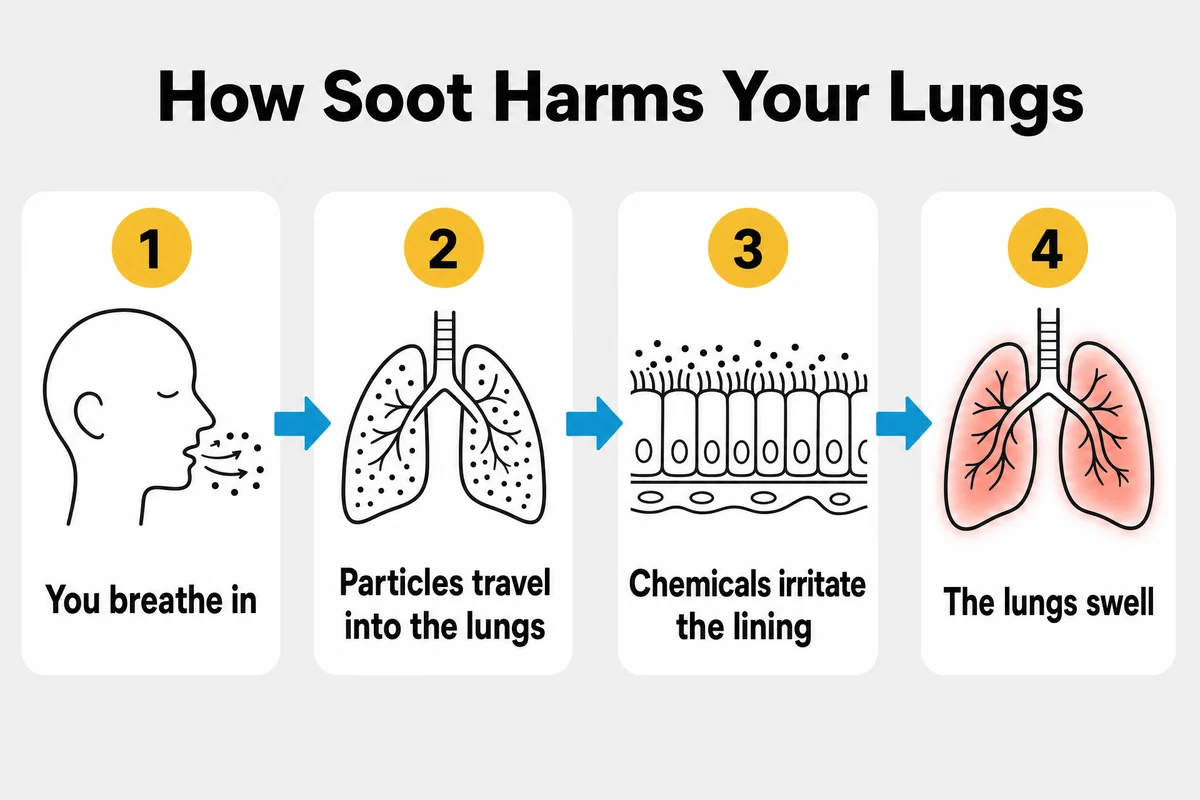
Here is the path, step by step. You breathe in. Tiny particles travel down the airways into the lungs. The toxic chemicals on them irritate the lining, and the lungs swell as they try to protect themselves. For someone with asthma, that swelling can close the airways. For a healthy adult, it can still mean days of coughing. Repeat exposure keeps the lungs inflamed, and the exposure adds up over weeks and months. Every exposure counts, and a house full of soot means repeat exposure. Here is how smoke and soot do their harm.
Many people recover from the short term effects. Others do not. Prolonged exposure to smoke can reduce lung function and feed chronic disease. Inhaling fine particulate matter triggers inflammation across the body and puts stress on your cells. Over time, that links to heart disease, cardiovascular disease and stroke. Studies connect fine particles with coronary heart disease and with increased mortality. These pollutants adversely affect the heart as well as the lungs, and fine particles can raise the chance of a heart attack. Heart and lung disease linked to fine particles can lead to premature death, even in people who never smoked.
The lungs take the first hit. When soot enters the lungs, the body fights it with inflammation. Over the years, soot exposure can lead to chronic obstructive pulmonary disease, which most people call COPD. Inhaling soot can lead to asthma and bronchitis. It can also cause ongoing respiratory issues, even when the person felt fine at first. Soot can settle in lung tissue and stay there.
The damage can spread. When tiny particles reach the blood stream, they can add to organ damage in places far from the lungs. Tiny particles are linked to organ damage well beyond the chest. Some of these health issues are slow, so people rarely link them back to a fire years earlier. Left alone, they can become serious health issues.
The UK has an official estimate that fine particle pollution is linked to between 29,000 and 43,000 deaths among adults aged 30 and over. The estimate relates to 2019 and was repeated in January 2026. It covers pollution from many sources, including smoke and soot. Fine soot can penetrate deep into the lungs, and that is what sits behind these numbers. It is a public health problem, not just a household one.
In London, a study published in June 2026 put the toll at the equivalent of 3,800 to 5,100 deaths in 2024. Each of those is a case of premature death. Not every case comes from fire, of course. But the same fine particles sit inside every plume of smoke, and long term exposure matters wherever it happens. We see the same risk on a smaller scale in every home we clean after a fire. Smoke and soot are part of the picture in every home fire.
Soot has a long history with cancer. In 1775, a London surgeon named Percivall Pott linked soot to cancer in chimney sweeps. It was one of the first times a job was tied to cancer. Among people exposed to soot every working day, the disease struck young. That is a clear case of occupational exposure, and it still teaches us something today.
The International Agency for Research on Cancer now classes outdoor air pollution and its particles as a cause of cancer in humans. Soot contains polycyclic aromatic hydrocarbons, which are known carcinogens. Soot can also carry heavy metals such as arsenic and cadmium. Soot exposure can lead to lung cancer and other cancers over time. Children, older adults and people with existing lung conditions carry the most risk.
Children breathe faster for their size, and their lungs are still growing. That means they take in more fine particles per kilo of body weight. Children exposed to soot may have lifelong respiratory issues. Smoke can also set off asthma attacks and make asthma symptoms harder to control. A child with asthma can go from fine to struggling for breath in minutes. Even short exposure can matter. Small children also put their hands in their mouths, so toxic soot on floors and toys can end up inside them. Smoke and soot are harder on children than on adults.
If you have kids, keep them out of the property until the soot is gone. That includes the garden if the smoke drifted there. Children have no way to judge the risk, so the choice has to be yours.
Older adults, people with heart disease and people with weakened immune systems struggle most with smoke. Smoke exposure can worsen chronic lung conditions like asthma and COPD. It can also make an existing heart problem worse. People with weakened immune systems find it harder to fight off chest infections after a heavy dose of smoke. These groups can get sick from levels of soot that others barely notice. People with heart disease face a higher chance of a heart attack after heavy smoke and soot exposure.
If anyone in your home fits this group, treat every soot covered room as off limits. Ask a friend or relative to take them in until the property is cleaned and tested. Their health matters more than a tidy kitchen.
Health risks also rise for anyone who stays in a sooty house for days. People with long running health issues, such as heart problems, lung problems or a weak immune system, can find that smoke adds to their health problems. If you are not sure whether you belong in this group, ask your GP. Your health comes first, and cleaning can wait.
Fire damage is not always visible. Floors can be weak. Wiring can be live. Hot spots can restart a fire hours later. Walls that look fine may hold trapped heat. A burned house has other health hazards too, such as broken glass, sharp metal and weak floors. Fire damage can hide behind walls and under floors. Smoke damage can sit in the loft long after the fire is out. Smoke and soot can also hide hazards on the floor. Wait for the fire service to tell you when you can go in.
If you have been told to leave, leave. Evacuation from contaminated areas can save lives when smoke exposure is severe. Cleaning can wait. Your lungs cannot, and neither can your health.
A strong smoke smell means smoke particles are still in the air or in the fabrics around you. Each time you move something, you stir them up again. Smoke and soot in the air are hard to see, even in good light. That makes the indoor air quality worse, not better. Your health is at stake each time you disturb it. Poor indoor air quality is one of the main reasons people feel unwell in a house after a fire. People with asthma may react to the smell alone, and poor indoor air quality can set off their symptoms within minutes.
Checking air quality matters after any fire. A smell is a clue, but it is not a test. Some toxic gases have no smell at all, and fine particles cannot be seen. If you are unsure, do not go in and ask a professional to check.
Dry wiping smears soot into paint, wallpaper and fabric. That turns a light film of smoke damage into a stain that is far harder to remove. Sweeping lifts fine soot into the air. Smoke and soot spread easily once they are disturbed. A normal vacuum is even worse, because most household filters let ultrafine particles straight back out of the exhaust.
Using HEPA filtration can cut the amount of fine particles in indoor air. That is why professionals use machines with a proper filter and sealed hoses. A cheap vacuum without one can spread the problem into rooms the fire never touched. Do not use water on soot covered walls either, because it can push the soot further in.
It is tempting to grab the strongest cleaner under the sink. Please do not. Some cleaning chemicals react with soot residue and turn it into a greasy smear. Mixing two products, such as bleach and an ammonia cleaner, can create toxic fumes. Those chemicals add to the smoke damage you already have, and they add to the risk for your lungs.
Burned plastics leave toxic soot that clings to skin, clothes and cloths, so it spreads as you wipe. Cleaning chemicals also leave their own fumes in a room with poor air. If the air is already thick with soot, you are asking your lungs to handle two threats at once.
Hold off on cleaning if any of these apply:
One of these is enough. Two or more means you should call for help before you pick up a cloth. A fire restoration team can test the air and tell you what is safe to touch.
If anyone has chest pain, difficulty breathing or a bad cough, see a doctor immediately. Call 999 for severe symptoms. For milder ones, call NHS 111 or your GP the same day. Tell them you were exposed to smoke, and tell them how long your exposure lasted. Smoke can cause trouble hours later, so do not wait for it to get worse. Get a health check even if you feel fine, because a mild cough can turn into serious health issues. If a child with asthma starts wheezing, call a doctor immediately and follow their asthma plan.
Open windows only if the outside air is clear and it is safe to enter. Do not run fans that blow soot around the room. Do not turn on the central heating or air conditioning, because ducts spread fine particles through the whole house.
Monitoring air quality helps during any smoke event. A trained team can use instruments to measure particles and gases. That tells you whether it is safe to stay.
Sometimes you need to grab medication, documents or a pet. Keep it short. Wear gloves, long sleeves, long trousers and sturdy shoes. That is basic personal protective equipment, and it keeps soot off your skin. Gloves also guard against health hazards such as glass and sharp debris. Toxic soot on skin and clothes can reach your mouth and eyes, so wash your hands and change before you eat or sleep.

A paper dust mask will not stop fine soot. A cloth face covering is no better. Wearing a properly fitted respirator, such as an FFP3 mask, protects against inhalation of fine particulate matter. It must seal against your face, so a dust mask that gaps around the nose does very little.
Photograph every room before you move a thing. Capture both the smoke damage and the fire damage. Fire damage shows where the flames reached. Smoke damage shows how far the smoke and soot travelled. Your insurer needs to see both, and the photos help any restoration team plan the job. Soot patterns, melted items and water damage show your insurer what happened. Cleaning first can wipe out that proof. Your insurer will also tell you what they will pay for and who they use. Some insurers work with a fire restoration firm and will tell you what they cover.
Soot does not stay where the fire was. Smoke moves through gaps, vents and wall cavities, then settles on cold surfaces. Smoke damage can reach rooms that never saw a flame. Porous materials such as fabric, wood and plasterboard soak up smoke particles and hold the smell for months.
Left alone, soot can leave acidic marks. It can tarnish metal, etch glass and discolour paint. That is why we say further damage starts as soon as the fire is out. The longer smoke damage sits, the harder it is to remove, and the more risk you carry every time you walk through the house.
Fire damage is what the flames and heat did. It burns, chars and weakens the structure. Smoke damage is what the smoke left behind. It stains, smells and coats everything it touches. A room can have heavy smoke damage with almost no fire damage at all.
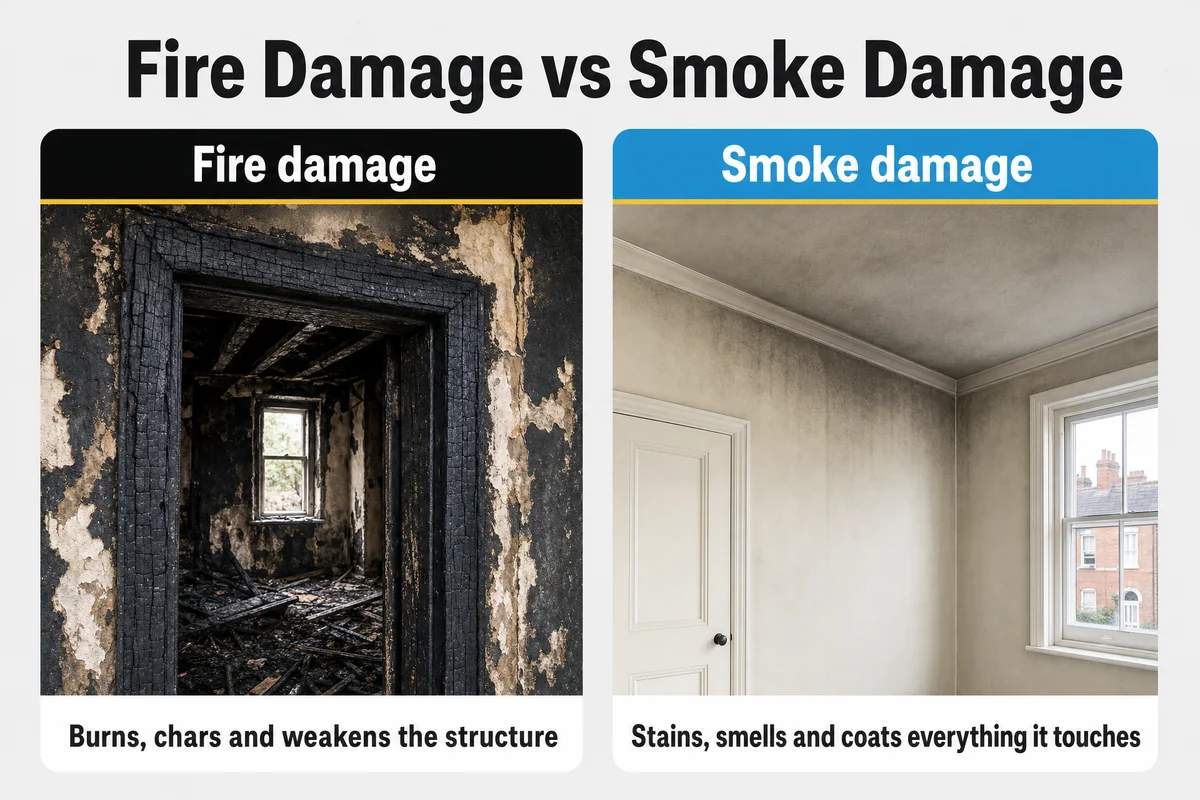
That split matters for health. Fire damage is easy to see and people avoid it. Smoke damage looks like a layer of dirt, so people try to wipe it. That is when the soot goes airborne. Both kinds of damage need to be checked before anyone decides what is safe to keep, clean or throw out.
Fire is not rare. Smoke and soot follow every one of them. In the 12 months ending June 2026, fire and rescue services in England attended 158,659 fires. Of those, 26,367 were dwelling fires. House fires like these put smoke into homes where people sleep, eat and raise children. Behind each one is fire damage, smoke damage and a family that has to deal with both.
In the same period, 164 people died in fires in homes in England, down 25% from the year before. There were also 6,683 non fatal casualties. Of those, 2,888 needed hospital treatment. Each number is a person, and many of them were hurt by smoke, not flames.
Not all soot comes from accidents. Smoke and soot from home burning add up across a whole street. In 2024, burning wood and coal in UK homes made up about 20% of the country's PM2.5 emissions. Indoor wood burning alone made up about 12%. A stove that burns dry wood at high heat lets materials burn cleanly. A stove that smoulders with damp logs does not, and it pours out soot.
If you burn wood or coal, a yearly visit from chimney sweeps helps. Sweeps clear the soot build up that can start a chimney fire. Fewer chimney fires means fewer house fires and less smoke in your home.
London's population weighted PM2.5 fell by about 28% between 2019 and 2024, which shows progress is possible. Even so, fine particle pollution is still a health concern. England has set a goal to cut population exposure to PM2.5 by at least 35% compared with 2018, with annual average levels of no more than 10 micrograms per cubic metre by the end of 2040.
A good fire restoration job starts with a check, not a cloth. The team looks at the fire damage first, then maps the smoke damage, tests the air and finds where the soot went. Then they seal off clean rooms, set up air scrubbers with HEPA filtration and put on the right protective gear. Only then does the cleaning start.

Smoke and soot removal follows a set order, from the top of the room down. Dry soot is lifted with the right sponges and filtered vacuums before any wet cleaning. That order stops the soot from smearing and keeps fine particles out of the breathing space.
Fire restoration is not just wiping walls. After a fire, teams often deal with smoke odour that has sunk into fabric and plaster. They also deal with water left by the fire service, which can cause mould within days if it stays damp. Mould is another of the health hazards after a fire. Contents such as clothes, books and electrical items need sorting into what can be saved and what cannot.
Good fire restoration also spots health hazards before they become a problem. It means testing and recording what was done, so you know the property is safe to move back into. It treats smoke damage and fire damage as two jobs with two sets of tools. When one is missed, the other tends to come back.
Professional cleanup is needed for safe fire restoration because the risks are real and hard to see. Smoke and soot can contain chemicals that harm the lungs, the heart and the blood stream. A tidy house is not a safe house. Only testing and the right tools tell you the difference.
Whoever you hire for fire restoration, ask a few questions first:
A firm that cannot answer these clearly is not ready for the job.
Not until the fire service has cleared it and the air has been checked. For the sake of everyone's health, wait. Even a small fire can leave fine soot and smoke particles behind. If anyone at home has asthma, a heart problem or is very young or old, stay somewhere else.
Not until the air has been checked. Smoke damage alone can fill a home with fine soot and toxic chemicals, even when the fire damage is small. Even brief exposure is a risk for a child, an older adult or anyone with asthma.
We advise against it. Water and dry cloths both spread soot into the surface. If the fire was tiny, kept to one pan or one spot and the air is clear, a careful wipe with a damp cloth may be fine. Wear gloves and a fitted mask, and stop if you cough or feel tight in the chest.
Until it is removed. Smoke and soot do not break down on their own. They sit in carpets, curtains, vents and dust, and every footstep can lift them again.
It depends on the size of the fire, the amount of smoke damage and how much water was used to put it out. A small kitchen fire is a very different job from a fire that spreads through several rooms. A good team will give you a plan once they have seen the property.
Smoke and soot hurt people quietly. A good fire restoration team treats the air, the building and your health as one job, with health first. The lungs, heart and blood stream are all in the line of fire, and children and older adults carry the most risk. Waiting before you clean is not a weakness. It is the move that protects your health and the health of everyone in your home.
This article gives general information and is not medical advice. If you feel unwell after a fire, speak to a doctor or call NHS 111. In an emergency, call 999.