We’re the UK’s Go-To Cleaning Company
High-Standard Cleaning with Compassion and Care.
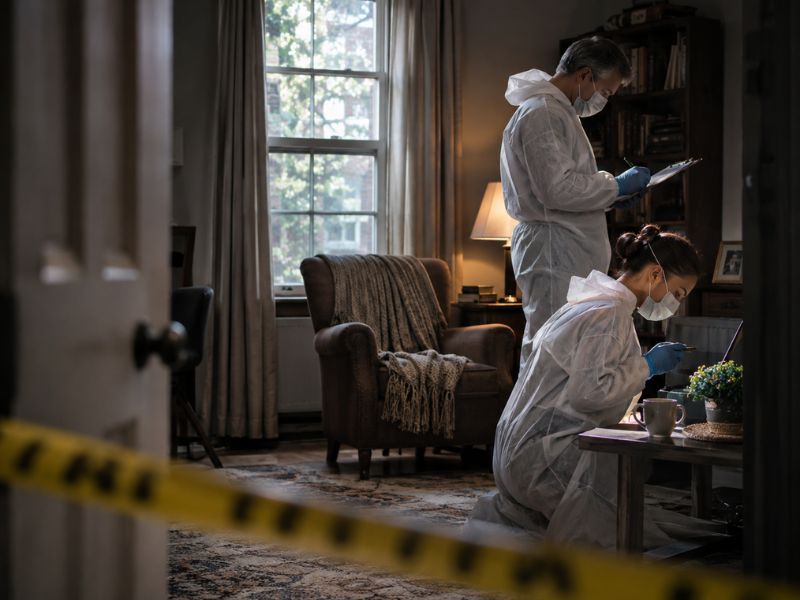
When a person dies alone and is found later, the police and paramedics attend first. They confirm the death, secure the scene and check for anything suspicious. Usually, nothing is. A coroner then decides if more checks are needed, and the next of kin are told once the identity is confirmed. Cleaning comes last. It needs a specialist team, because decomposition leaves biological waste that ordinary cleaning cannot remove.
If you have just found someone, call 999 if the death may be recent. Call 101 if it is clear the death is not recent. Do not try to clean anything yourself.
At Scrubbed With Love, we are usually called in after the police have left, so this guide covers what follows up to the final clean.

An unattended death occurs when a person dies alone and is not discovered straight away. It can go unnoticed for hours, days or weeks. No official UK figure records how many people die alone and stay undiscovered, or how many unattended deaths happen each year.
In 2025, around 8.6 million people lived alone in the UK, according to the Office for National Statistics. That was 29.5% of households, up from about 7.7 million in 2015. Nearly half, 49.6%, were aged 65 or older, and 63.9% of those were women.
Living alone does not mean someone will die unattended, but without regular contact, a fall or a sudden illness can lead to a death no one sees. This can happen to anyone, and an unattended death is often found among elderly individuals living independently. Someone in poor health with little social contact can lie undiscovered for several days.
The causes fall into four groups:
Most cases come down to natural causes and long-term illness, and an unknown illness can end a life suddenly.
You may be reading this in shock. A 999 call sends help and the police, which matters if there is any chance someone is alive and needs medical care. It is the urgent route. A 101 call suits a death that is clearly not recent. Dealing with this alone is hard, so give the address and what you saw.
Touch as little as you can and do not move the body unless you are told to. Avoid attempting to wash, tidy or air out the room, because evidence matters. Attempting to clean a scene after decomposition can spread contamination, because wiping pushes fluids into new parts of the home. Once officers have released the property, contact a specialist cleaning service.
The emergency services attend first. Once crews have arrived, they check for signs of life, confirm the death, secure the scene and notify the authorities. They record where the death occurred and how the home looked when they arrived.
Officers want to know if anything is suspicious or if there is evidence of a crime. Investigators look at the scene for signs of a struggle or disturbance. If they find foul play, it becomes a criminal investigation. An unattended death does not automatically mean a crime took place. Decomposition makes this harder, because the longer someone has been dead, the harder it is to find the cause.
Investigators work to establish who the person was and how they died, using documents, neighbours and medical history. The next of kin must then be notified, usually a family member, and officers often deliver the news in person. The deceased is taken to a mortuary, often at a local hospital.

In England and Wales, a coroner is the independent judicial officer who investigates deaths with an unknown or unexplained cause. That covers many unattended deaths, because no one saw what happened.
In 2025, 570,988 deaths were registered in England and Wales, up 0.4% on 2024. Of those, 147,814 were reported to coroners, about 26% of all registered deaths, a fall of around 15% on the year before. Being reported does not mean a long process. In 2025, 52,036 cases needed neither a post-mortem nor an inquest, and in many cases a doctor’s evidence of a natural cause is enough.
An unattended death does not automatically need a post-mortem. When the cause is unclear, one is ordered to find it. About 75,900 were ordered in 2025, around 51% of reported deaths.
A post-mortem is more than an external check. It can include toxicology, histology and other specialist tests. Toxicology looks for alcohol, drugs or other substances that may have played a part, and featured in about 23,063 post-mortems, roughly 30% of those ordered. Histology means studying tissue samples under a microscope to identify medical conditions, and featured in 15,931.
Some cases go to an inquest, which is a court inquiry into who died and how, when and where. The average inquest in England and Wales took about 31.3 weeks in 2025. Not every reported death ends in one, because the process can close once medical evidence shows a natural cause.
A statutory medical examiner system began in England and Wales on 9 September 2024. Medical examiners independently scrutinise deaths that are not under investigation. The rules differ across the UK. Scotland uses procurators fiscal, and Northern Ireland has its own Coroners Service.
Time is critical here. Someone can be dead for several days before anyone knows, and some are not found for weeks. How long ago the death occurred decides how far the damage spreads. Decomposition begins within 24 to 72 hours of death. This can occur in any home.
Decomposition fluids soak into carpets, flooring, mattresses and furniture. The odour penetrates porous materials and the surfaces around them. Even after the deceased has been removed, the property may need specialist remediation, because biological contamination is not something ordinary cleaning can fix.
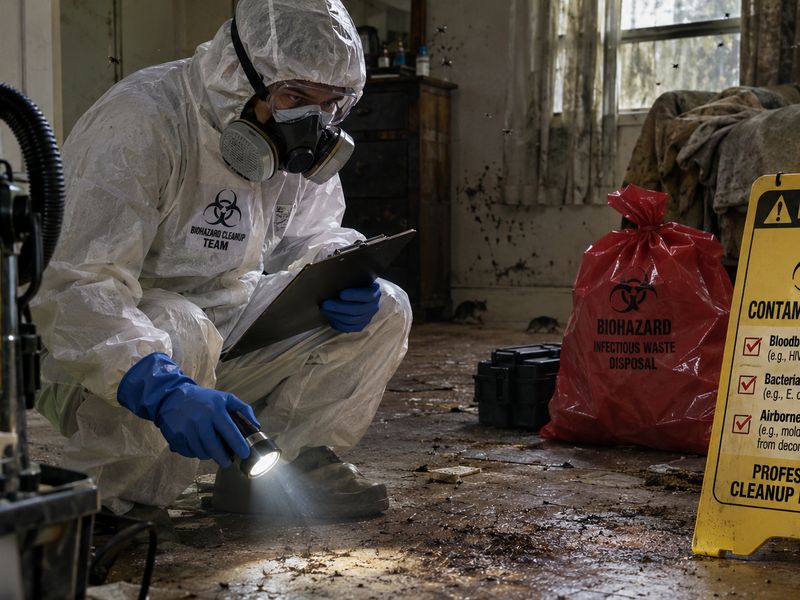
Decomposition fluids can carry bloodborne pathogens such as HIV and hepatitis. Bacteria and gases released during decomposition pose a serious risk to anyone who breathes them in. Insects and rodents are drawn to the property too. These hazards are why the work counts as a biohazard job, and why trained professionals follow strict safety rules.
It is not officers or crews, and it is not the funeral home. Once the scene is released, arranging the clean usually falls to whoever is responsible for the home.
If the person owned the home, the next of kin or the executor usually arranges and pays for it. A family member can also act on behalf of the estate. In a rented home, the landlord often steps in. In social housing, housing associations and local councils usually send their own contractors. Where no one else can step in, local authorities may get involved, although it varies by area.
A general cleaning service will not know how to clean this safely. Handling hazardous materials without training puts the cleaner and the next visitor at risk. Problems can occur if the job is done badly, and disposing of the waste correctly is a legal requirement. That is why the job goes to certified professionals.
Before the clean starts, the team walks the property to see how far decomposition has spread. They work in full PPE, including suits, gloves and respirators, for their own safety, because the biological waste on site is a real hazard. Ask any service you are considering what training their professionals hold.
Items soaked with fluids often cannot be saved, so carpets, mattresses, flooring and soft furnishings may need to be removed and bagged. All biohazard waste and hazardous materials must be disposed of under UK regulations, using licensed carriers.
Hard surfaces get a clean first, then hospital grade disinfectants to eliminate bacteria and viruses. Odour neutralisation follows, using equipment such as fogging machines, and it targets the source of the smell, not just the air. Good teams respond quickly and arrive in unmarked vehicles. Many biohazard cleaning companies across the UK offer a round-the-clock service, and the best professionals treat the home, and the people grieving, with respect.
We looked at three UK sources: an older Checkatrade guide to crime scene cleaning, and the published ranges from two UK cleaning companies. They gave £300 to £3,500, £350 to £2,500 and over, and £500 to £3,000. Averaged out, that is roughly £380 at the low end and £3,000 at the high end, with a middle figure of about £1,700.
The price of an after-death cleaning depends on how long someone lay undiscovered, how far decomposition spread and how much flooring had to be removed. Ask for a written quote and check what each service includes.
These prices are a rough guide and the actual cost varies from one property to the next.
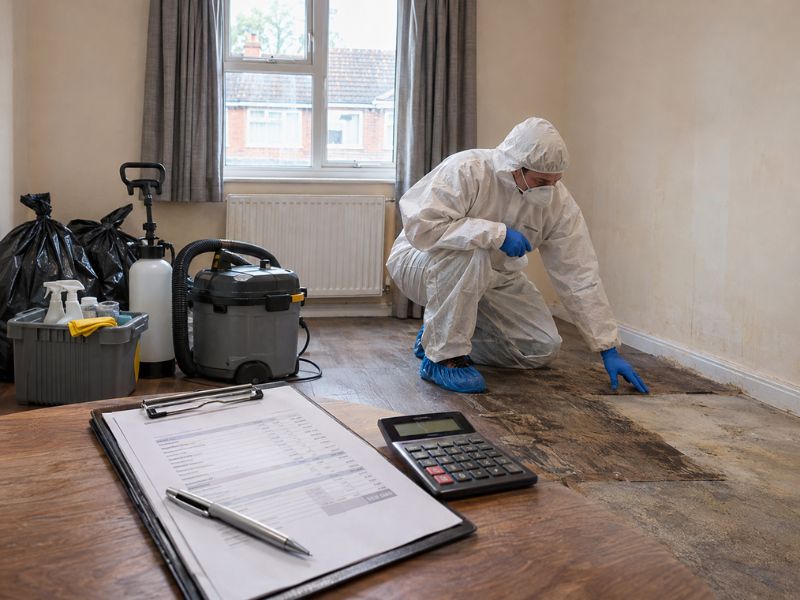
A clean after an unattended death can take hours or several days. If flooring has to come out, the clean takes longer.
The gap between discovery and the funeral varies. If the death needs investigating, the funeral director usually cannot set a date until the body is released. With no post-mortem that can be quick, but a post-mortem takes longer, and an inquest longer again. A discovery can involve the police, ambulance crews, funeral directors, landlords and specialist cleaners. Each party involved works to its own timeline, so ask who is involved at each stage.
For many families, the hardest part is not knowing what comes next. After an unattended death, these steps help:
When considering clearing a deceased person's house, wait until the relevant authorities confirm that the property can be safely accessed.
Families often feel shock and guilt, and your own health matters too. Samaritans are free to call on 116 123, at any time. Cruse offers bereavement support on 0808 808 1677. If anyone is having thoughts of suicide, tell someone today.
The investigation and post-mortem figures come from the Ministry of Justice annual statistics for 2025. The household figures come from the Office for National Statistics report Families and households in the UK: 2025. The prices come from published UK pricing guides.