We’re the UK’s Go-To Cleaning Company
High-Standard Cleaning with Compassion and Care.
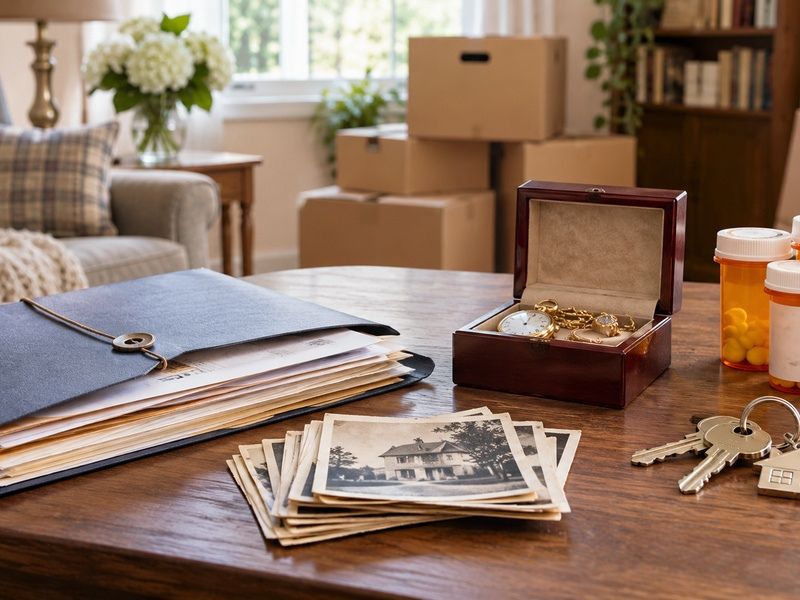
Find the will and the other important documents before you move anything. Keep the property secure and the power on. Hold back anything that might be worth money until the estate is in order. Take every tablet, cream and inhaler to a pharmacy. Then sort what is left into five piles: keep, sell, donate, recycle and dispose.
The process is simple once you know the order. You can start sorting before probate is granted. There is no legal deadline to clear a house, but home insurance and rent can set the pace. The executor is legally responsible for the estate, so the big calls are theirs.
At Scrubbed With Love, we work with families on house clearance after a death. We see the same avoidable mistakes again and again. Understanding what happens after someone is found dead can help families prepare for the practical responsibilities that follow. This guide shows you how to skip them.

A death sets off a lot of paperwork. In 2025, 570,988 deaths were registered in England and Wales, up 0.4% on 2024. Of those, 72,272 were attributed to dementia and Alzheimer's disease, which is 12.7% of all registered deaths. Many of those families also face a house full of belongings.
The probate process is the legal step that gives someone the right to deal with the estate. In 2025, 242,821 probate applications were made and 239,091 grants were issued. The average grant took about five weeks, compared with more than eight weeks in 2024. Applications stopped by errors, disputes or missing information took an average of 15 weeks between October and December 2025. Only 127 contested probate cases were recorded all year, so disputes are rare. Stopped applications are the bigger risk, and good records help you avoid them.
The executor named in the will manages the estate. With no will, a close relative, often one of the family members, can apply to act as administrator. Either way, one person is legally responsible, and every big choice about the house should go through them.
Start with the property. Lock up, collect the post and check for leaks. Physical security matters because an empty house attracts trouble. Keep the gas, electric and water on, and keep paying the bills, because you need light and heat to sort and clean. Call the home insurer too. Many insurers cut back cover after 30 to 60 days, so ask what yours says.
If the death is under a coroner's investigation, check with the relevant authorities before you disturb anything, including papers and medicines.
Clearing a deceased person's property is emotionally draining. You pick up a coat, a recipe card, a half-read book. Each one carries emotional weight. It is normal to feel overwhelmed.
Physical work and feelings run on different clocks. A crew can empty a house in a day. Families can need several weeks. Rushing the process rarely helps, and a slow clearance is fine. Many people find it easier with support, so ask friends to help with the heavy lifting. Take photographs of items as you go, because it eases the pain of letting go and gives you a record of what was there. A clear plan helps you respect your loved one's memory while still getting the job done.
Clear categories speed up the whole process. Use the same five from day one:
Unwanted items with no immediate value go into recycle or dispose. That stops long debates over a chipped mug. For example, a cracked plate can go straight to the last pile without a family vote.
Cardboard boxes help here. Label each box by category and location before you fill it. Give furniture and bulky goods their own corner of the garage or drive so they do not block the doors. Pack personal items such as glasses, watches and letters in separate boxes for the family to go through together.
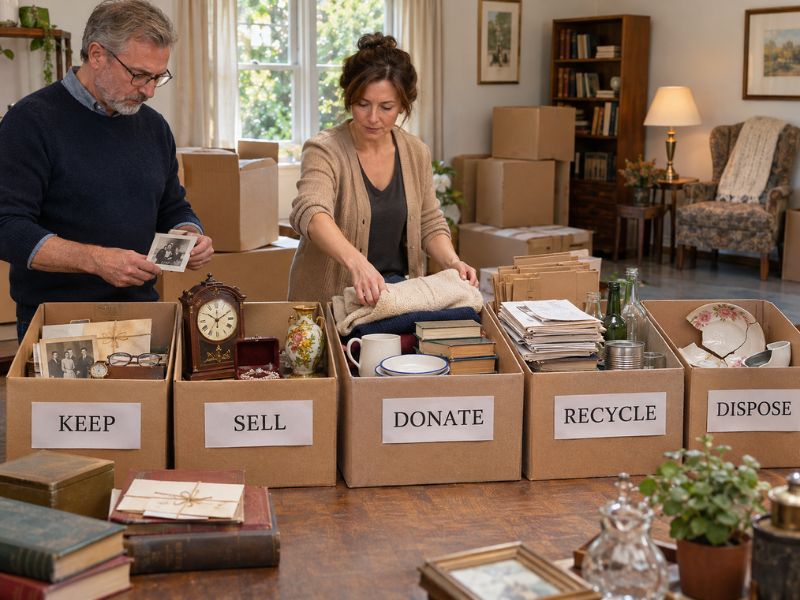
Involve family members before anything leaves the house. Ask each person to list what matters to them. Arguments over a loved one's belongings can hurt a family for years. Walk through the house together, or share photos if people live far away. A friend or family member can hold the checklist and note who wants what. Neighbours and friends often offer help too, so say yes.
Sorting important documents should be one of your first steps. Find the will and probate papers before you clear anything, because they show who decides what. Finding wills, property deeds, bank statements, pension records, insurance policies and family certificates can help prevent delays when you run an estate.
Here is a checklist to work from:
They are not always in a filing cabinet. Check bedside drawers, the loft, the garage, kitchen cupboards and old storage boxes. Look in coat pockets, biscuit tins and the back of wardrobes. Family photographs, letters and certificates can also help show family relationships and who may be entitled to inherit.
Do not forget devices. Old mobile phones, computers and storage devices can hold online banking, insurance accounts and subscriptions. They also hold personal details that need to be erased securely before anyone sells or gives them away. Keep the devices and passwords together until the estate is settled.
Keep every document safe until the probate process is complete. Use one box with a lid and put one person in charge of it. You will need financial documents to value the estate, to see what the estate must pay and to apply to the probate registry.
When you register the death, use the Tell Us Once service. It tells most government bodies in one go. Banks, insurers and utility firms still need a call from you. You will also need to post the driving licence back to the DVLA.
Records matter even more when no relative can be found. In that case an unclaimed estate can eventually pass to the Crown. The government's Bona Vacantia accounts recorded £14 million in receipts from estate cases in 2024 to 2025.
Here is the rule: do not dispose of valuable items before the probate valuation. Personal belongings and household contents are called chattels in estate valuation. The Office for National Statistics counts household contents and possessions as a category of personal wealth, so a house full of ordinary things can hold real monetary value.
Antiques, artwork, jewellery, collectibles, vehicles and other household possessions all add to the estate's total. Families often focus on bank accounts and the property, and overlook valuable items in a drawer. An inherited watch or jewellery collection can be worth far more than family members first think. Have particular items professionally valued before you sell or dispose of them, and do not let valuable items leave the property until that is done.
Photograph the deceased person's belongings room by room before you move anything. Take extra photos of certain items, such as paintings, clocks and silver. Move delicate possessions like china and glass to one safe room.
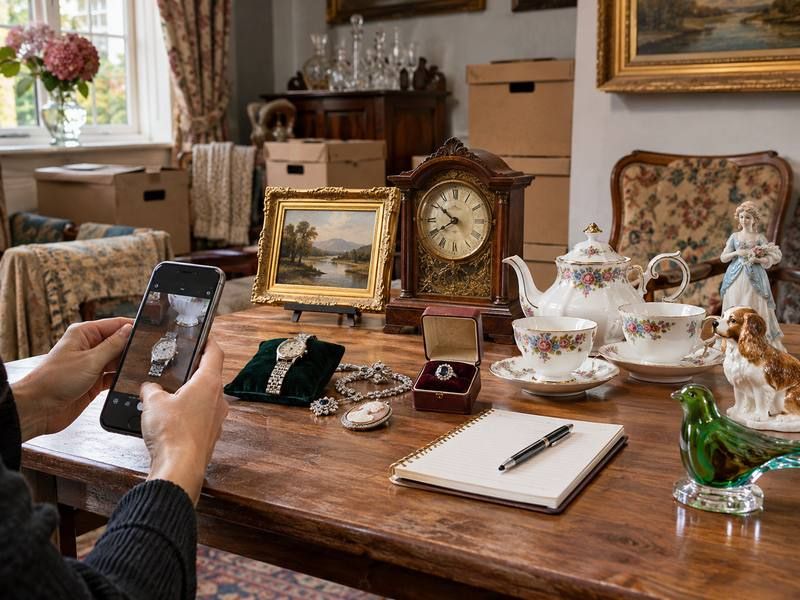
Sentimental value and financial value are not the same. A worn cardigan may fetch nothing at an auction house and mean everything to a daughter. Set aside sentimental items for each person who wants them. Photos, letters and recipe books are good places to start.
A memory box helps. Give each person a box and let them fill it over a few weeks. If two people want the same thing, agree a fair method before you start, like taking turns or drawing names. Treat every one of your loved one's possessions as a possible keepsake until everyone has had their say.
Keep the keys, the post and recent bills. Keep a list of everything that leaves the house, who took it and what it was worth. Those are practical considerations, but they save weeks of questions later. Key items such as spare keys and the post are best held by the executor.
Medicine hides in more places than you would think. Old prescription medicines can sit in bathroom cabinets and fridges long after treatment has ended. Check bedside tables, handbags and coat pockets too. You may find prescription tablets, liquid medicines, inhalers, creams, patches and specialist treatments.
The waste is bigger than one house. Around 3,400 tonnes of partly used medicines were estimated to have been thrown away in England in 2025. The NHS cost of wasted medicines was around £480 million, and the amount wasted would fill about 75 swimming pools.
Take them to a community pharmacy. Community pharmacies take back unwanted medicines, including those left by someone who has died. Handing everything over is the safe disposal route, and it keeps tablets away from children, pets and the water supply. It is a short, free process.
Never flush tablets down the toilet or pour liquids down the drain. Ask a pharmacist if you are unsure. Controlled drugs and specialist medication can need extra handling, so tell the pharmacist when you hand them in. Needles and syringes are handled separately, so ask your pharmacist or council first.
Bag everything and keep it out of reach until you go. Never pass medicines to someone else to use. They were prescribed for one person only.
Once items are valued, you can sell them. A car boot sale suits everyday goods like tools, crockery and garden gear. An auction house is better for antiques, art and jewellery. Furniture often sells better as a set. Keep a record of every sale, because the money belongs to the estate and not to the person who ran the stall.
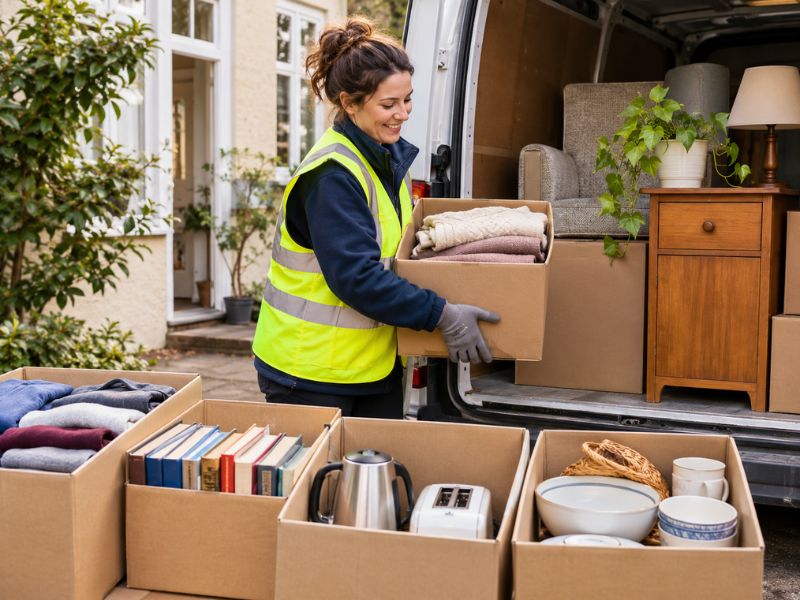
Clothing, books, electrical appliances and usable household goods can often be donated, reused or recycled instead of sent to landfill. Take them to a charity shop, or ask local charities what they need. Many local charities offer free collection for bigger pieces such as furniture. Check first, because many cannot take worn mattresses or broken electricals. Donate items that are clean, safe and working. Plenty of house clearing jobs end with a van full of donations for this reason.
UK households produced about 26.2 million tonnes of waste in 2024, and the household recycling rate was 44.5%. It varied by nation: 58.6% in Wales, 50.1% in Northern Ireland, 43.8% in England and 42.7% in Scotland. Wales was 14.8 percentage points ahead of England.
Sorting at the start of the job is what lifts those numbers. Separate paper, glass, metal and textiles into their own cardboard boxes or bags. Take bulky furniture to the local tip or book a council collection. Anything broken or unsafe goes in the dispose pile. Splitting belongings into keep, sell, donate, recycle and dispose makes the clearance more environmentally responsible.
Work one room at a time. Sort possessions one area at a time, not by type. Start with the room that holds the fewest memories, often the spare room or garage, because early wins build momentum. Friends can help with carrying, packing and driving. If you hire a van, you pay for the tip fees too. A family clearance works best in short sessions. Agree rest breaks and stop when someone gets upset.
Some jobs are too big, too far away or too heavy for the family. A professional house clearance service can handle sorting and recycling, manage valuable and delicate items and help with paperwork, such as waste transfer notes. It also lifts the emotional load, which matters when you are already tired. Many house clearance teams can drop donations at charity for you.
Check the licence first. By law, you must take reasonable steps to check that anyone taking your waste is a registered waste carrier, and you can face a fine if their load ends up dumped. Ask for the waste carrier number and search it on the Environment Agency register. Be wary of very cheap cash quotes with no paperwork, because they often leave out licensed disposal costs. Hiring licensed professionals helps make sure items are handled legally and ethically. Look for a house clearance company with probate experience, recent reviews and insurance. Ask for a written quote and a list of what was removed.
A full house clearance of an average three-bedroom house takes about one day for a crew. A single room takes a few hours. Family-led clearing stretches longer, because everyone has work and a life to run.
The deadline that matters is tax, not the empty house. Estates worth more than £325,000 may owe inheritance tax, and allowances can raise that figure. If tax is due, you must pay it by the end of the sixth month after the month of death, or HMRC adds interest. That legal deadline sits alongside any dates set by a landlord or insurer, so check both early. Property is often the biggest part of an estate, so ask the solicitor or agent what happens once the property is empty.
No official body publishes house clearance prices, so we checked four 2026 UK price guides and averaged them. Three broke prices down by property size. The fourth gave a UK-wide average of about £757. For a one-bedroom flat, the average came out at about £315. For a three-bedroom house, the average house clearance cost was about £765, with a typical spread of roughly £500 to £1,030. A four-bedroom house averaged about £1,300. London and the South East usually run 10% to 30% higher.
Several things push the costs up: stairs with no lift, poor parking, heavy items, large volumes and tip fees, which are charged by weight. Tip fees and labour make up most of the clearance costs. Check whether a quote includes VAT, because guides differ on that. Ask any clearance service for a fixed written quote, and ask how the process works on the day, so clearance costs do not creep up on you.
Treat these prices as a rough guide, because the actual cost varies with access, volume and where you live. What you pay depends on the job in front of you.
Who pays for house clearance after death? The estate pays. House clearance is a legitimate estate expense, and the executor can settle the bill from estate funds. If you pay first, keep every invoice so the executor can repay you from the estate.

Take it one box at a time. Find the papers first, keep what might be worth money, hand medicines to a pharmacy and let the estate cover the cost of help. If it feels like too much, that is normal. At Scrubbed With Love, we know how heavy house clearance work can be, and we are happy to answer questions at any stage. Once the property is clear, you can finally breathe.
This guide is general information, not legal or financial advice. Speak to a solicitor about your own estate, and check GOV.UK for the latest rules.