We’re the UK’s Go-To Cleaning Company
High-Standard Cleaning with Compassion and Care.
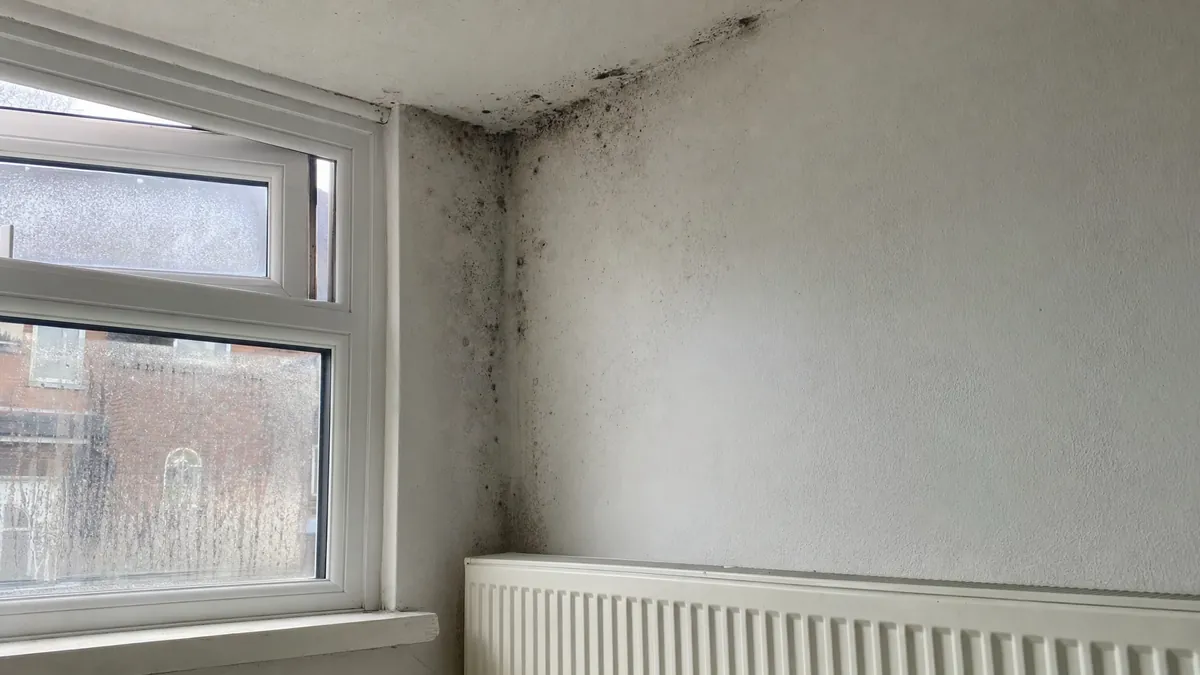
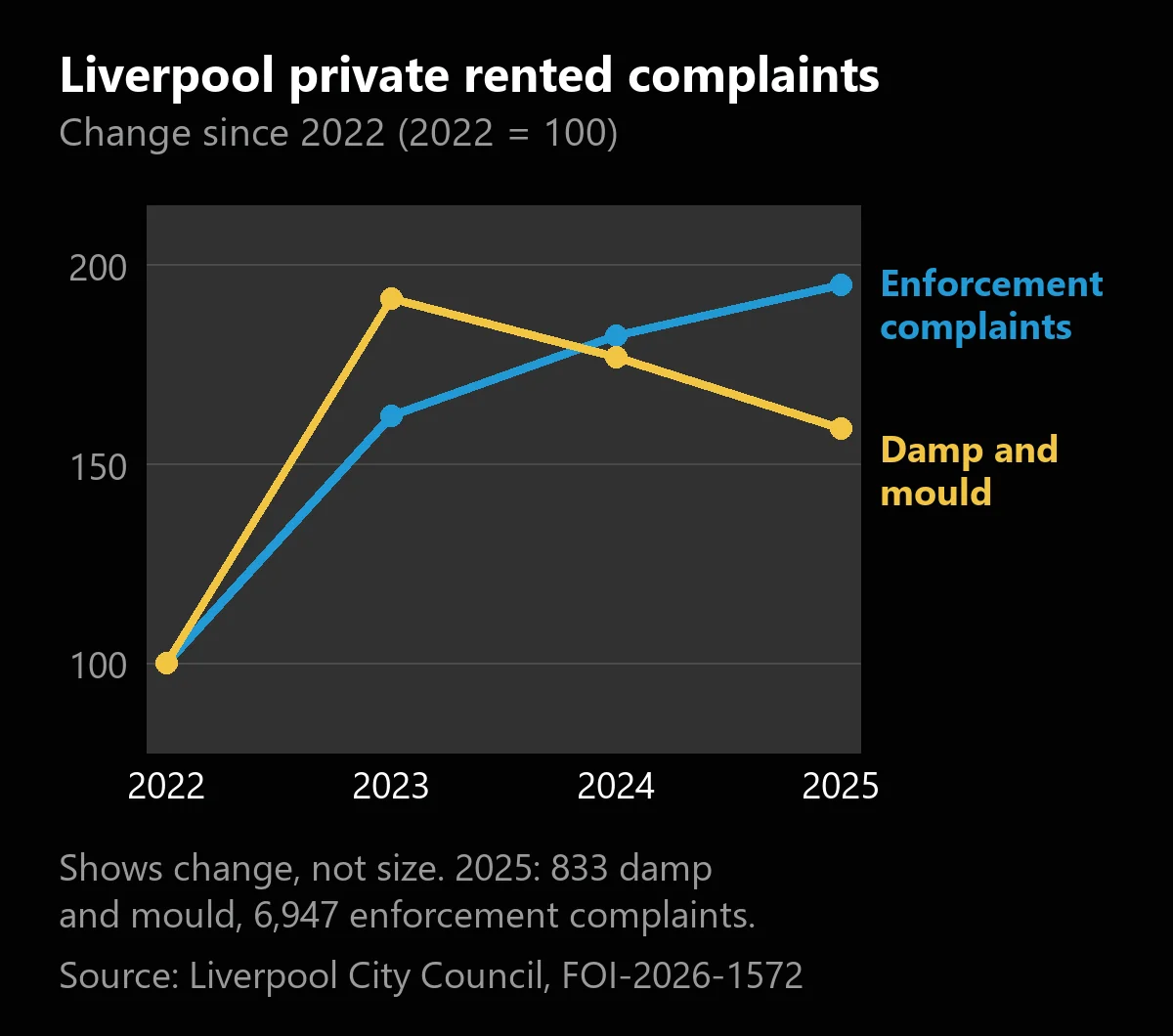
Liverpool City Council recorded 833 damp and mould complaints about private rented homes in 2025. That is down 16.9% from a peak of 1,003 in 2023, but still 59.0% higher than the 524 recorded in 2022 (FOI-2026-1572).
Private rented housing enforcement complaints went the other way. The council logged 6,947 in 2025, up 94.8% on 3,566 in 2022. Reports of discarded needles, syringes or sharps fell from 65 in 2021 to 26 in 2025, a drop of 60.0%.
All figures were supplied by Liverpool City Council on 25 June 2026 under Freedom of Information request FOI-2026-1572. More complaints do not prove that homes got worse. More people may know how to report a problem, and the city's landlord licensing scheme may change what gets recorded.
We asked Liverpool City Council for five years of figures on damp and mould, private rented housing complaints, needles and contaminated waste. This table shows everything the council sent back.
| Year | Damp and mould complaints (private rented) | Private rented housing enforcement complaints | Reports of discarded needles, syringes or sharps (whole council) |
|---|---|---|---|
| 2021 | Not supplied | Not supplied | 65 |
| 2022 | 524 | 3,566 | 46 |
| 2023 | 1,003 | 5,782 | 58 |
| 2024 | 926 | 6,498 | 31 |
| 2025 | 833 | 6,947 | 26 |
| 2026 (part-year, dates unconfirmed by the council) | 442 | 3,487 | Not supplied |
The council also told us it had 25 hazardous waste service requests across the last five calendar years, with no yearly split. You can download all of these figures as a CSV file.
The 2026 figures cover only part of the year, and the council has not yet told us which dates they cover. We have left them out of every percentage, average and chart on this page.
Here is the pattern for damp and mould complaints about private rented homes, year by year.
So the number almost doubled in 2023, then dropped two years running. By 2025 it was 16.9% below the peak. It was still 59.0% above 2022. That works out at about 2.3 damp and mould complaints every day in 2025.
The council's figures do not say why. One thing we do know is the timing. In November 2022 a coroner's report found that two-year-old Awaab Ishak died from a lung condition caused by long exposure to mould in his family's home in Rochdale (Prevention of Future Deaths report, 16 November 2022).
The case was widely reported. It may have made more tenants aware that damp and mould is a health risk and that they can report it. That is a possible link, not a proven cause. The 2023 rise could also reflect changes in how complaints were logged, or the selective licensing scheme getting into its stride.
Maybe, but the data cannot tell us. Fewer complaints could mean fewer damp homes. It could also mean landlords are dealing with problems before tenants go to the council, or that some tenants have stopped reporting. We would need inspection results, not just complaint counts, to know which.
For context, damp is a bigger problem in private rented homes than in other homes across England. The English Housing Survey found that 10% of private rented homes had a damp problem in 2024, compared with 7% of social rented homes and 4% of owner occupied homes (English Housing Survey 2024 to 2025, published 29 January 2026). Those are national figures for England, not Liverpool.
Liverpool City Council recorded 6,947 private rented housing enforcement complaints in 2025, up 94.8% on 2022. That is about 19 complaints a day.
| Year | Complaints | Change on the year before |
|---|---|---|
| 2022 | 3,566 | No earlier figure supplied |
| 2023 | 5,782 | +62.1% |
| 2024 | 6,498 | +12.4% |
| 2025 | 6,947 | +6.9% |
The rise has slowed each year, but the total kept going up. Unlike damp and mould complaints, it did not fall after 2023.
Liverpool's selective licensing scheme started on 1 April 2022, the first year in this data (Liverpool City Council, selective licensing). Most private landlords in the areas it covers need a licence and must meet its conditions.
A scheme like this can bring more complaints to light. Inspections find problems, tenants learn where to report, and more work gets logged. So the rise may say as much about the council looking harder as it does about conditions getting worse.
After a public consultation, the council's Cabinet is due to decide on a new selective licensing scheme for 2027 to 2032 on 15 December 2026 (Liverpool City Council forward plan). We will update this page once the decision is made.
We do not know yet. The council listed the two figures separately and did not say whether damp and mould complaints are counted inside the enforcement total. We will ask the council to confirm this. Until it does, please do not read the damp figure as a share of the enforcement figure.
The council recorded these reports of discarded needles, syringes or sharps across all its services, not just housing.
| Year | Reports |
|---|---|
| 2021 | 65 |
| 2022 | 46 |
| 2023 | 58 |
| 2024 | 31 |
| 2025 | 26 |
That is 226 reports over five years, or an average of 45.2 a year. The 2025 figure is 60.0% lower than 2021.
These are reports to the council, not a count of needles found. One report could be a single syringe or a whole stairwell of them. People may also report needles to someone else, such as a housing association, the police or a landlord, and those reports would not show up here.
So the fall is real in the council's records, but it does not prove there are fewer needles on Liverpool's streets or in its homes.
If you find a needle, do not pick it up with your bare hands. Our guide on what to do if you find a needle covers the safe steps. For larger areas, such as gardens, empty properties or communal spaces, our team carries out needle sweeps using full PPE.
We want to be clear about the gaps, so nobody stretches these numbers further than they go.
The numbers are a reminder that damp and mould is still one of the most common problems in Liverpool's private rented homes. Here is what the council's own guidance says, and how to get it fixed.
The council asks tenants to tell their landlord first and give them a fair chance to fix the problem. If you cannot agree on repairs, you can report it to the council through its Licensing and Regulations Portal, or email the Private Sector Housing team with your address, what is wrong and photos (Liverpool City Council, report poor private housing conditions).
The council's damp and mould guidance also says a landlord cannot simply blame damp and mould on how you live, and must take your report seriously (Liverpool City Council, damp and mould guide for renters). If the council inspects and finds a serious hazard, environmental health officers can require the landlord to carry out repairs.
Whether you are a tenant or a landlord, a clear record makes everything easier. Take dated photos when you first spot damp or mould anywhere in the property. Keep a written account of every call and message about it. Note when repairs were promised and when the work was done. If the problem comes back, those records show what work has already been tried.
Many people searching for Liverpool damp and mould complaints want to know about compensation. We are a cleaning company, not a legal firm, so we cannot advise on claims. If you are thinking about compensation, Shelter and Citizens Advice can explain your options for free.
What we can say is how the rules are changing. Social housing tenants can take complaints to the Housing Ombudsman, which can order compensation. Private landlords will have to join a new landlord ombudsman under the Renters' Rights Act, which the government expects in 2028 (GOV.UK, Renters' Rights Act implementation roadmap).
Awaab's Law already sets time limits for social landlords to deal with damp and mould. Our post on Awaab's Law and mould explains how it works. The government is now consulting on extending it to private rented homes, with the consultation open until 18 December 2026 (GOV.UK, extending Awaab's Law to private rented tenancies). Until new rules are set, private landlords are not covered by it.
Cleaning mould off a wall does not fix damp. If water is getting in through a leaking roof, blocked gutters or a failed seal, or if condensation has nowhere to go, the mould will come back. The cause needs to be found and fixed by the right trade first.
Once the repairs are done, the mould that is left still needs to be dealt with safely. That is where our specialist mould removal service comes in, for landlords, letting agents and tenants. If you are not sure what you are dealing with, our guide to damp, condensation and mould explains the difference.
We asked Manchester City Council the same questions. Manchester records damp under a wider heading, "Dampness & Leaks", so the two cities' counts are not like for like. The trend is strikingly similar, though: both peaked in 2023 and were about 17% lower by 2025. You can read the Manchester council figures in full, and see both cities side by side in our North West comparison of council damp data.
We sent this Freedom of Information request to Liverpool City Council. It was received on 26 May 2026 and answered on 25 June 2026 under the Freedom of Information Act 2000, reference FOI-2026-1572. We asked for the most recent five full calendar years, broken down by year where possible:
For points 1 and 2, we asked about private rented housing only. For points 3 and 4, we asked for reports made to the council as a whole, across any department that records them.
We have used the council's own labels. "Damp and mould complaints" and "private rented housing enforcement complaints" are the council's categories, and we will ask it to confirm what each one includes. The council headed its sharps table "Complaints", although we asked for reports. For point 4, the council said our wording was broad and gave the number of hazardous waste service requests instead.
Percentage change is the difference between two years divided by the earlier year, rounded to one decimal place. Daily figures are the 2025 total divided by 365. The chart shows each series as an index, with 2022 set to 100, so you can compare how fast each one changed rather than how big it is. In 2025 there were 833 damp and mould complaints and 6,947 enforcement complaints. We have not used the 2026 part-year figures in any calculation.
Josie Cookson, founder of Scrubbed With Love Cleaning Company, said: "We asked for these figures because damp, mould and needles are problems we are called out to deal with. We wanted to see what the council's records show, rather than guess."
Last updated: 28 November 2026.
We will ask the council to confirm the 2026 date range, and we expect full-year 2026 figures in February 2027. We will update this page when the answers arrive.