We’re the UK’s Go-To Cleaning Company
High-Standard Cleaning with Compassion and Care.
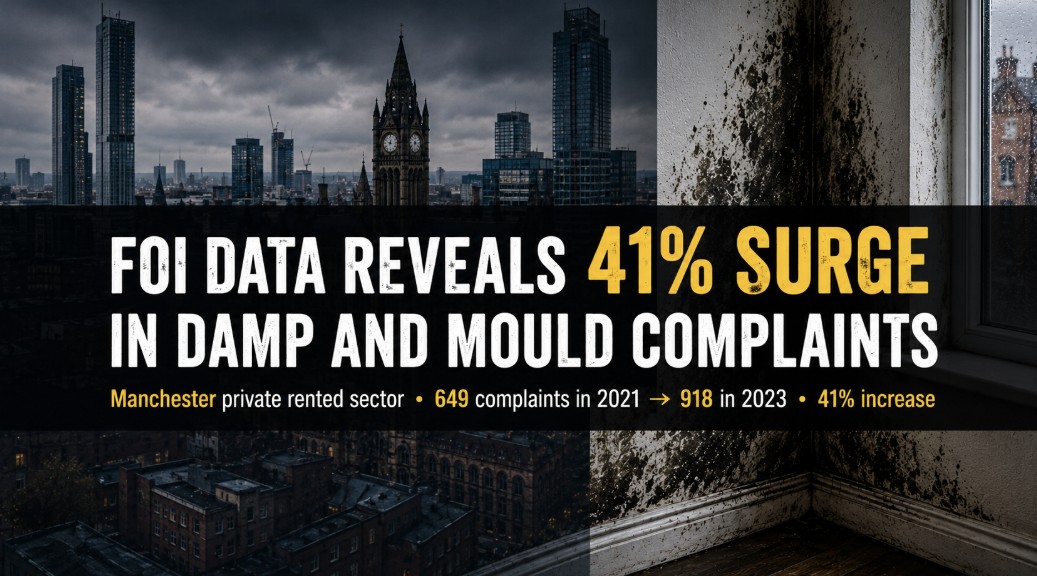
When we submitted a Freedom of Information request to Manchester City Council, we were not entirely surprised by what came back. As a specialist cleaning company working across Liverpool & Greater Manchester, we see the consequences of substandard housing conditions on a regular basis. But seeing the scale of the problem laid out in official figures is still striking.
The data covers five years, from 2021 to 2025. It captures damp and mould complaints in private rented housing, general housing enforcement requests, and reports of discarded needles and sharps across the city. Taken together, the numbers tell a story that is not just about housing policy or council capacity. They tell a story about what happens to real people living inside properties that are making them ill, and what is left behind when those situations are not dealt with quickly or thoroughly enough.
The single most significant finding in the data is the sustained rise in damp and mould complaints linked to private rented properties in Manchester.
In 2021, the council received 649 complaints. By 2023, that figure had risen to 918 - a 41% increase in just two years. The numbers have eased slightly since then, falling to 897 in 2024 and 759 in 2025, but they have not returned to 2021 levels. Even at their most recent point, Manchester is recording significantly more damp and mould complaints than it was at the start of this five-year window.
The full picture year by year:
It is worth placing these figures in their national context. The death of two-year-old Awaab Ishak in Rochdale in 2020, caused by prolonged mould exposure in his family's social housing property, fundamentally shifted the conversation around damp and mould in the UK. The subsequent coroner's ruling, the media coverage and the eventual introduction of Awaab's Law all raised public and tenant awareness considerably.
And yet Manchester's complaint figures peaked two years after Awaab's case became widely known, and remain elevated today.
There are a few possible explanations for this. Greater awareness may have encouraged tenants to report problems they previously suffered in silence. Advocacy organisations may be doing more to help renters understand their rights. Or the underlying problem may simply be getting worse as housing stock ages and affordability pressures push people into lower-quality properties.
In our experience, the answer is probably all three.
This section matters because it is where awareness meets reality, and where the gap between a complaint being logged and a property being made safe becomes genuinely dangerous.
Mould is not a cosmetic issue. It is a biological contamination. Left untreated, it spreads rapidly through porous building materials - plasterboard, timber, grout lines, soft furnishings, behind skirting boards and inside wall cavities. Some species of mould, including Stachybotrys chartarum, which is commonly referred to as black mould, produce mycotoxins that can cause serious respiratory harm.
For vulnerable tenants, including children, elderly residents, and anyone with asthma, compromised immunity or existing respiratory conditions, prolonged exposure to mould spores is not a minor inconvenience. It is an active health threat.
By the time many tenants formally report a problem to their council, the mould has often been present for weeks or months. And by the time enforcement action leads to any kind of resolution, the contamination can be extensive.
Standard cleaning products - bleach, surface sprays, over-the-counter mould removers - do not deal with established mould growth. They may remove visible surface staining temporarily, but they do not neutralise the spores embedded in building materials, and they do not prevent regrowth. Proper mould remediation requires specialist treatment, containment of affected areas, and in serious cases, controlled removal of contaminated materials.
This is why we exist.
At Scrubbed With Love, our mould and damp remediation service is designed to go beyond surface treatment. We identify the full extent of the contamination, treat affected areas with professional-grade antifungal solutions, and work with landlords and tenants to ensure the environment is genuinely safe before the job is signed off.
The FOI data also reveals that general private rented housing enforcement complaints have remained stubbornly, persistently high throughout the five-year period.
Not a single year in this dataset falls below 1,600. The 2023 figure of 1,755 is the highest on record across the five years. And while the number has drifted downward slightly since then, the overall direction of travel is flat rather than falling.
What these figures represent, in practical terms, is a council housing enforcement team fielding an enormous and unrelenting volume of complaints from tenants in private rented accommodation. Manchester City Council does significant work in this space, but no local authority has unlimited capacity, and the volume of complaints means that some situations will wait longer than others for action.
For landlords, the regulatory environment is tightening. The Homes (Fitness for Human Habitation) Act 2018 gives tenants the right to take direct legal action against landlords whose properties fall below the required standard, without needing to wait for council enforcement. The provisions of Awaab's Law - which mandate specific response timeframes for landlords when damp and mould are reported - extend obligations further still.
Acting quickly, with the right specialist support, is not just the right thing to do. It is increasingly the legally prudent thing to do.
The third strand of data in our FOI request relates to discarded needles and sharps reported to Manchester City Council's street cleansing teams. These figures cover public spaces, streets, alleyways, communal areas and open land rather than housing specifically.
Across the full five-year period, the council received at least 1,076 reports of discarded sharps requiring street cleansing intervention. The drop from 2021 to 2022 is significant and may reflect changes in service demand or operational recording. Since then, the figures have plateaued, hovering between 182 and 199 for the last four years.
A plateau is not the same as resolution. Discarded needles remain a live contamination risk in communities across Greater Manchester. They are found in communal bin stores, car parks, stairwells, playgrounds, alleyways and open scrubland. They pose an immediate puncture and bloodborne disease risk to anyone who encounters them, including children, pets, refuse collectors and residents simply going about their day.
Professional sharps clearance is not optional. Discarded needles must be handled and disposed of in strict accordance with hazardous waste regulations. It is not a job for a general cleaning crew, and it is not a job for a member of the public or a well-meaning landlord with a pair of gloves.
Our sharps and needle clearance service covers residential and commercial sites across Greater Manchester. We attend quickly, handle all waste in compliance with current legislation, and leave the site safe.
Looked at together, these three datasets - mould complaints, housing enforcement requests and needle reports - describe a city where a significant number of people are living and working in environments that carry genuine health risks.
Some of those risks arise from substandard housing. Some arise from the wider public environment. Some arise from the conditions left behind after trauma, neglect or criminal activity. What they have in common is that they require specialist intervention to resolve safely, and that the gap between a problem being identified and that problem being properly dealt with is often where the real harm occurs.
Council services do crucial work, but they are not specialist cleaning companies. Enforcement action can prompt a landlord to address an issue, but it does not clean the mould off the walls. A street cleansing team can collect a reported needle, but they are not equipped to decontaminate the surrounding area or assess hidden sharps risk in the same site.
That is where specialist biohazard, contamination and remediation cleaning comes in.
Scrubbed With Love is a North West based specialist cleaning company covering Liverpool & Greater Manchester and the surrounding area. We exist specifically to deal with the situations that fall outside the scope of standard cleaning - the jobs that require specialist training, professional equipment and proper waste handling procedures.
Our services include mould and damp remediation, sharps and needle clearance, biohazard cleaning, commercial deep cleaning, and domestic and end-of-tenancy cleaning for properties that have been left in a condition requiring more than a standard clean.
We work with private landlords, letting agents, housing associations, property management companies, commercial premises and private individuals. We are discreet, thorough and compliant with all relevant health, safety and waste disposal regulations.
If you are a landlord dealing with a mould complaint and need the property remediated properly before your tenant returns. If you are a property manager who has discovered discarded needles in a communal area. If you are a tenant who has moved into a property that is not in an acceptable condition. If you manage commercial premises and need a deep clean carrying out to a professional standard. We can help.
The situations that require specialist cleaning rarely improve by waiting. Mould spreads. Contamination worsens. The longer the delay between identifying a problem and resolving it properly, the greater the risk to the people in that space and the greater the potential liability for those responsible for it.
If you have a mould problem & need mould removal that needs professional attention, contact Scrubbed With Love today. We cover Liverpool, Manchester and the wider Liverpool & Greater Manchester area and offer prompt response times for urgent cases.