We’re the UK’s Go-To Cleaning Company
High-Standard Cleaning with Compassion and Care.
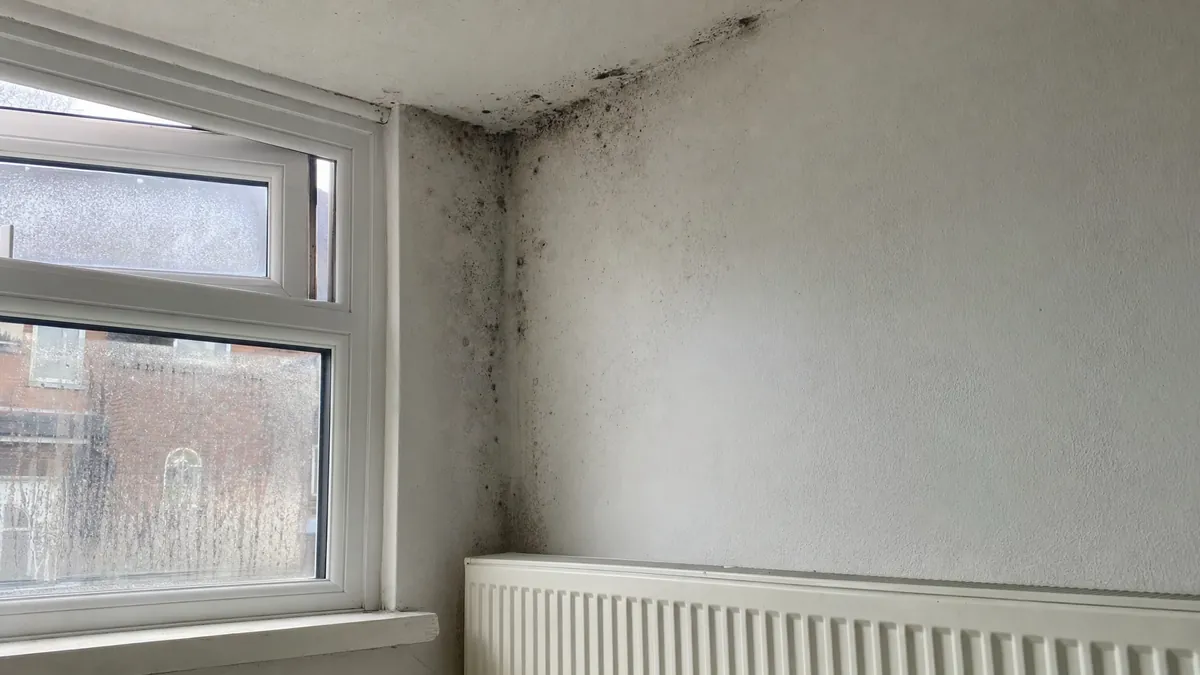
Damp figures in both Liverpool and Manchester peaked in 2023 and were about 17% lower by 2025. Liverpool City Council's damp and mould complaints fell 16.9% from 2023 to 2025, and Manchester City Council's Dampness & Leaks cases fell 17.3%.
Housing caseloads moved apart. Liverpool's private rented housing enforcement complaints rose 94.8% between 2022 and 2025, while Manchester's Housing Requests for Service rose just 1.1%.
Sharps reports fell in both cities between 2021 and 2025: by 60.0% in Liverpool and 40.1% in Manchester. Each council counts these in different ways, so this page compares trends, not raw numbers.
We sent the same request to both councils on 26 May 2026. Their answers used different categories, years and laws, which is why we compare how the numbers moved rather than how big they are.
| What we asked about | Liverpool City Council | Manchester City Council |
|---|---|---|
| Damp | Damp and mould complaints, private rented, 2022 to 2025 plus a 2026 part-year | Dampness & Leaks, 2021 to 2025 (includes leaks) |
| Housing caseload | Private rented housing enforcement complaints, 2022 to 2025 plus a 2026 part-year | Housing Requests for Service, 2021 to 2025 |
| Sharps | Reports of discarded needles, syringes or sharps, whole council, 2021 to 2025 | Street Cleansing Requests (Sharps/Needles), 2021 to 2025 |
| Law used | Freedom of Information Act 2000 | Environmental Information Regulations 2004 |
| Reply date | 25 June 2026 | 22 June 2026 |
In both cities the damp figure climbed to a peak in 2023 and then fell for two years in a row.
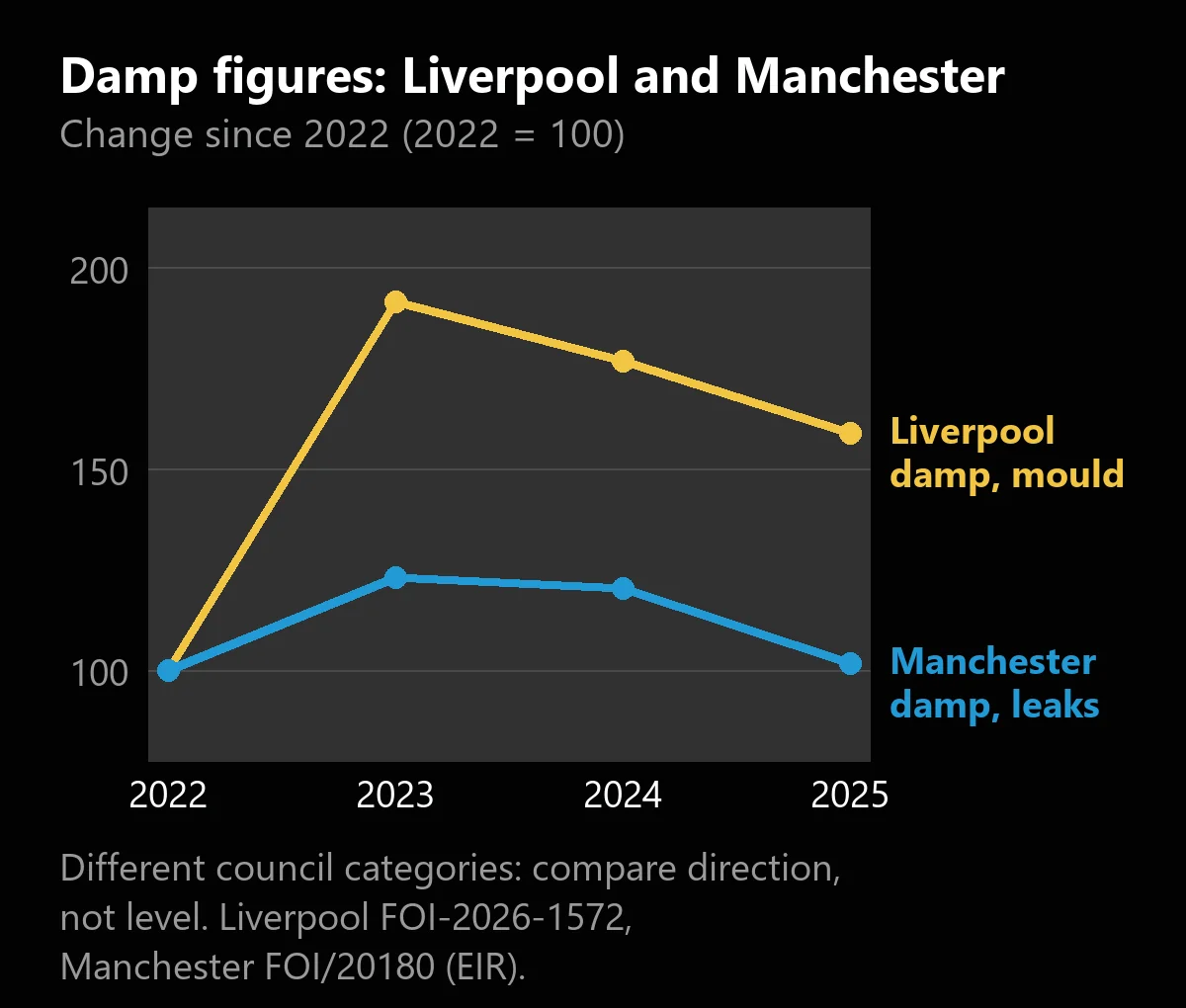
Liverpool's rise into 2023 was much steeper: up 91.4% in one year, against 23.1% in Manchester. Because Manchester's category includes leaks, we do not compare the two cities' totals directly.
In November 2022 a coroner's report found that two-year-old Awaab Ishak died from a lung condition caused by long exposure to mould in his family's home in Rochdale (Prevention of Future Deaths report, 16 November 2022). The national attention that followed may have led more tenants to report damp and mould in 2023. That is a link in timing, not a proven cause.
The second measure tells a different story in each city.
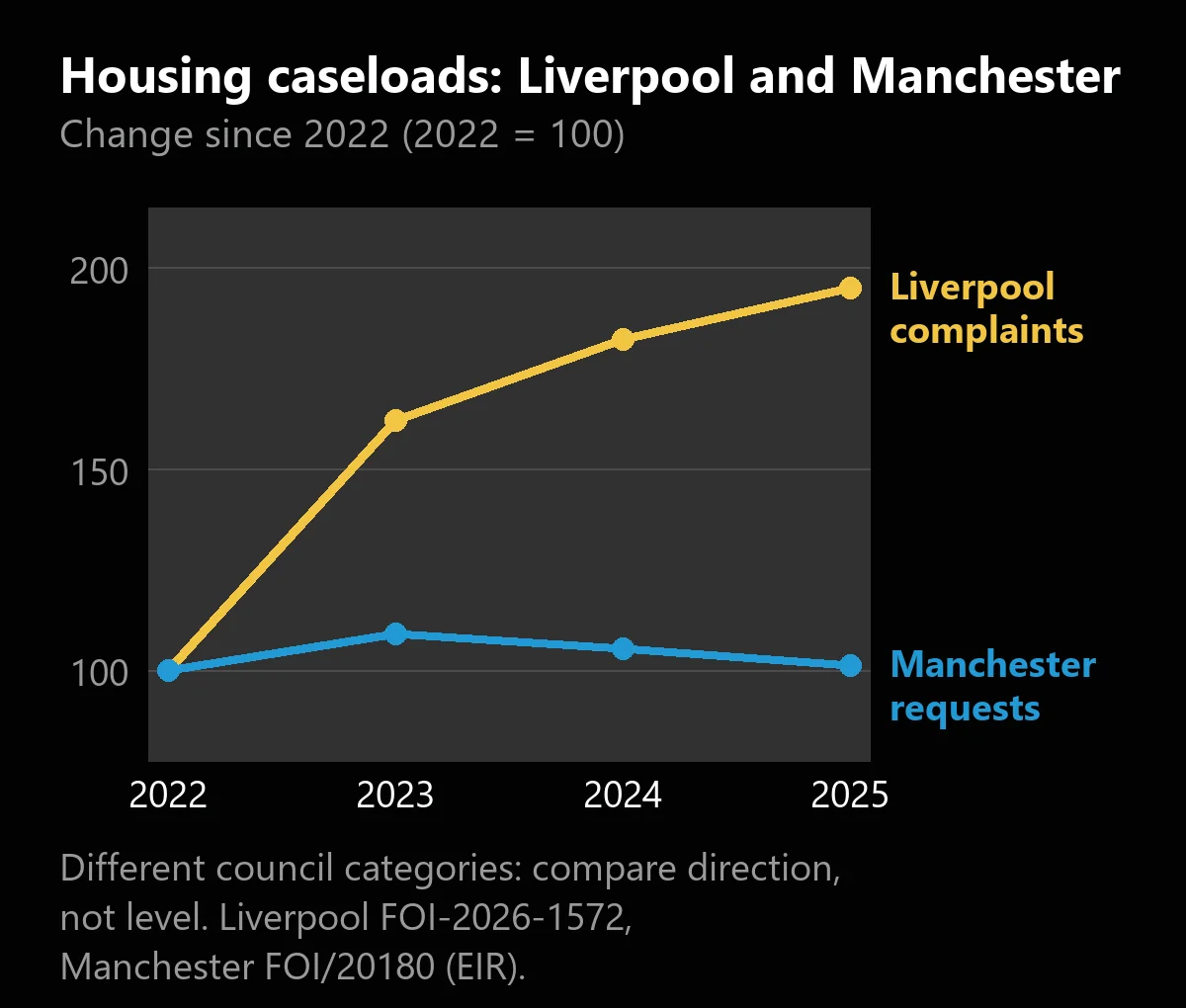
Liverpool's private rented housing enforcement complaints rose from 3,566 in 2022 to 6,947 in 2025, up 94.8%. Manchester's Housing Requests for Service moved from 1,609 to 1,627 over the same years, up 1.1%.
The gap may say more about how each council works than about the homes themselves. The two categories are different. Liverpool's selective licensing scheme started on 1 April 2022 and may bring more problems to light, as licensed homes are checked and tenants learn where to report. Liverpool's Cabinet is due to decide on a new scheme for 2027 to 2032 on 15 December 2026 (Liverpool City Council forward plan).
Liverpool recorded 65 reports of discarded needles, syringes or sharps in 2021 and 26 in 2025, down 60.0%. Manchester recorded 304 street cleansing requests for sharps and needles in 2021 and 182 in 2025, down 40.1%.
The two councils count these through different routes. Liverpool's figure covers reports across the whole council, while Manchester's comes from street cleansing. A report is also not the same as a needle found. So both falls are real in each council's records, but they do not prove there are fewer discarded needles. Our guide on what to do if you find a needle covers the safe steps.
Damp is more common in private rented homes than in other homes across England. The English Housing Survey found damp in 10% of private rented homes in 2024, against 7% of social rented homes and 4% of owner occupied homes. It also found that 22% of private rented homes did not meet the Decent Homes Standard (English Housing Survey 2024 to 2025, published 29 January 2026). These are national figures for England.
In social housing, condensation, damp and mould made up 34% of repairs complaints decided by the Housing Ombudsman in 2025 to 2026, and it upheld more than 75% of them (Housing Ombudsman annual complaints review, 15 September 2026). The Ombudsman covers social landlords, not private ones.
Damp and mould is still one of the most common problems in private rented homes. Tenants should report it to their landlord in writing, keep dated photos and go to their council if nothing happens. Awaab's Law already covers social housing, and our post on Awaab's Law and mould explains it. The government is consulting on extending it to private rented homes until 18 December 2026 (GOV.UK consultation).
Mould cleaning comes after the cause is fixed, not before. Our guide to damp, condensation and mould explains the difference, and our mould removal service deals with what is left once repairs are done.
Each city has its own page with every figure, the full request wording and the method.
We plan to add more North West councils in 2027.
Both requests asked for five years of figures, broken down by year, on damp and mould, private rented housing complaints, needles and contaminated waste. Liverpool's reference is FOI-2026-1572 and Manchester's is FOI/20180. The full request wording is on each city page.
Percentage change is the difference between two years divided by the earlier year, rounded to one decimal place. The charts show each series as an index, with 2022 set to 100, so you can compare direction and speed of change rather than size. You can download both councils' figures as a CSV file.
Last updated: 28 November 2026. We will ask both councils for full-year 2026 figures in January 2027 and expect to update this page in February 2027.