We’re the UK’s Go-To Cleaning Company
High-Standard Cleaning with Compassion and Care.
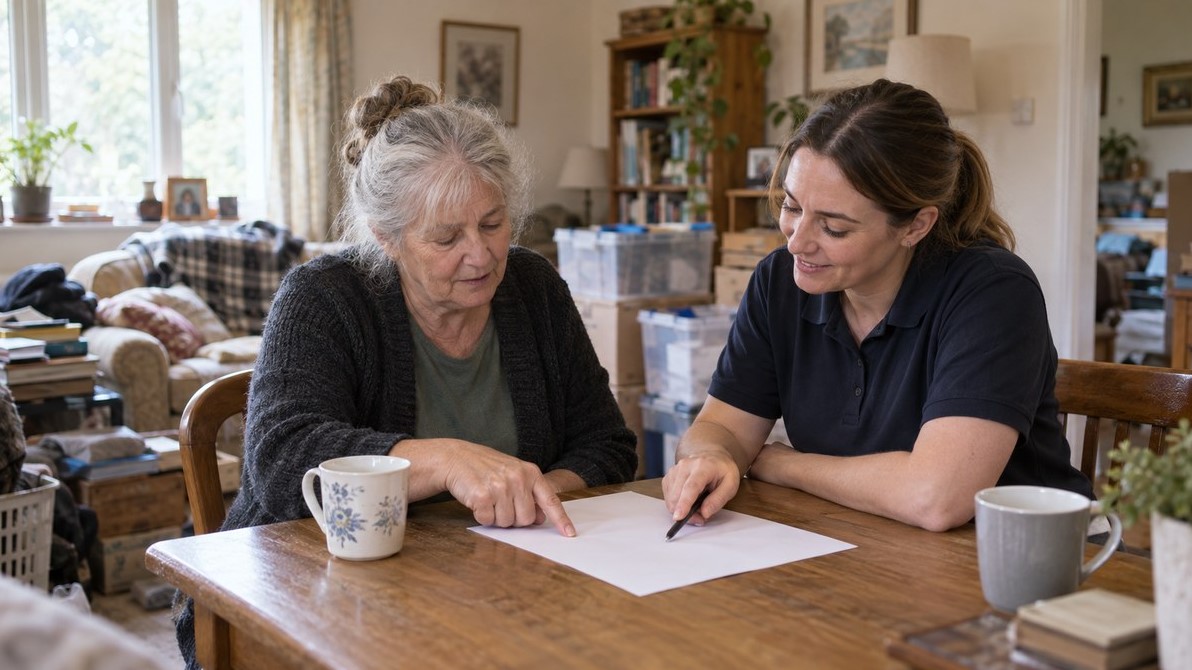
Every hoarded-home clean has a moment before it: a conversation about what will actually happen when someone arrives with bin bags and good intentions. That conversation should happen before the first box is opened, not during it.
The question this guide answers is a practical one: what needs to be agreed before anyone starts moving things? Not the whole clean-out. Not a timetable for clearing every room. Just the first stage: a single, bounded piece of work the resident has actually agreed to, with a clear end point everyone can recognise.
This is a planning guide, not a persuasion guide. If you're looking for help starting a conversation with a relative who hoards, Helping a Relative With Hoarding covers that ground. This article picks up from there: once a resident is willing to consider some help, how do you turn that willingness into a safe, specific, resident-led first visit, and put it in writing, so everyone involved knows what was agreed?
The centrepiece is a first-stage agreement you can copy, adapt and use before a first visit, whoever ends up providing the help.
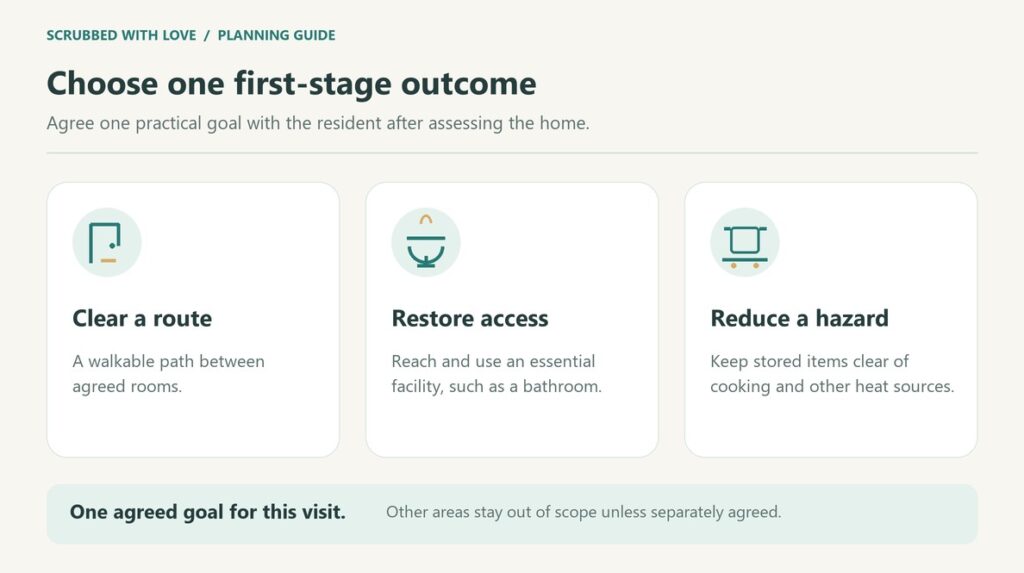
A first stage is not a smaller version of a full clear-out. It's a different kind of task altogether: one specific, agreed outcome that makes the property meaningfully safer or more liveable, achieved without deciding the fate of everything the resident owns.
In practice, a first-stage outcome usually looks like one of a small number of things:
None of these require touching most of the property. That's the point. A first stage succeeds by solving one real problem well, not by making a small dent in every room.
Which of these is right for a particular home depends on what a proper assessment finds, not on a fixed checklist. Scrubbed With Love's hoarder cleaning service begins every job with a private consultation and a discreet assessment visit precisely because the right first task can't be chosen from a distance. A blocked fire exit calls for a different first stage than a bathroom nobody can use. The assessment comes first; the agreement later in this guide is what you write down once you know what you're agreeing to.
A first-stage agreement usually has up to four kinds of people around it, though not every case needs all four:
The person who raises the alarm is not automatically the person who can approve what leaves the property. A worried relative or a landlord issuing a warning can trigger a first-stage conversation, but neither one, by itself, gives permission to discard someone else's possessions. Where the resident has capacity to make that decision, it stays theirs to make: GOV.UK's guidance on mental capacity is clear that an unwise-seeming choice is not, on its own, evidence of incapacity.
The agreement below has a specific field for this: who may enter, who may photograph, who may move items, and who may approve disposal. Filling it in honestly, before the first visit, avoids the far harder conversation that happens when someone assumed they had authority they didn't.
Before any planning agreement is filled in, there needs to be an actual conversation with the resident, not a form pushed in front of them. Mind's guidance on helping someone who hoards is direct about this: listen to what the person wants, and don't treat a total clear-up as the only measure of success.
A handful of open questions tend to do more work than any checklist:
The answers shape everything that follows, including which of the outcomes described above actually fits this resident, in this property, right now. Mind's guidance is equally direct that a complete clear-out may be neither achievable nor necessary for an initial safety goal.
Some residents and supporters find it easier to describe a starting point using a shared reference rather than first impressions alone. The Clutter Image Rating, hosted by HoardingUK, uses a simple sequence of pictures for a living room, kitchen and bedroom, from clutter-free through to very severely cluttered. It's not a diagnosis, a legal threshold, or permission to remove anything; it's just a common vocabulary that can sit alongside the conversation above, if the resident finds it helpful.
Alongside the conversation, someone with the right training needs to walk the property and check the things that most often turn a cluttered home into a dangerous one:
London Fire Brigade's guidance for carers and support workers flags blocked exits, combustible items near heat sources and overloaded electrics as recurring causes of hoarding-related fires, and the Brigade's own figures back this up: crews attended 1,028 hoarding-related fires across London in 2025, up 8% from 954 in 2024, with 226 caused by cooking and a further 137 by items placed too close to a heat source (see the January 2026 release for the full figures). Since 2021, London alone has recorded 974 injuries in hoarding-related fires.
This review sets the agenda for what a first-stage outcome should actually fix, but it has a limit. If the review turns up anything that looks like sharps, needles, significant biological contamination or a structural concern, the right response is to pause and bring in a specialist, not to work around it. This guide doesn't cover how to handle those situations directly; it covers how to recognise that a situation needs a different kind of help before the first visit goes ahead.
Putting the safety review and the resident's own priorities together should point to one clear first task, not a list of five. The examples below are hypothetical only, written to show how the same principle plays out differently in different homes; they are not real Scrubbed With Love jobs.
Hypothetical example A: a blocked hallway. The safety review finds the only exit route blocked with stacked boxes and furniture. The resident's own priority, separately, is to be able to get her post from the letterbox without difficulty. Agreed first-stage outcome: clear a walkable path from the front door to the kitchen, wide enough to pass through easily. Deferred: the spare bedroom, the garage, and a wardrobe the resident has specifically said must not be touched.
Hypothetical example B: an unusable bathroom. The resident can no longer reach the bath or the toilet without moving items each time, and says this is what worries him most. Agreed first-stage outcome: clear and clean the bathroom itself, and the direct route to it from the bedroom. Deferred: the rest of the flat, including a hallway the resident agrees to deal with once the bathroom is sorted.
Hypothetical example C: a cooking-area fire risk. A relative's concern and the safety review agree: paper and packaging are stacked close to the hob, and a portable heater sits nearby. The resident isn't ready to discuss the wider clutter, but agrees to a narrow first stage. Agreed first-stage outcome: clear a safe zone around the cooker and reposition the heater, in line with London Fire Brigade advice on keeping heat sources clear of stored items. Deferred: everything else.
In every example, the agreement names what's being done and, just as importantly, what isn't, at least not yet. That second half matters. A resident who can see, in writing, that the rest of their home isn't up for discussion today is far more likely to trust the next visit too. Research summarised by the Health Research Authority backs this instinct: it favours a slow, steady approach to decluttering, and specifically cautions against rapid 'blitz' clear-outs, which can cause distress without solving the underlying problem.
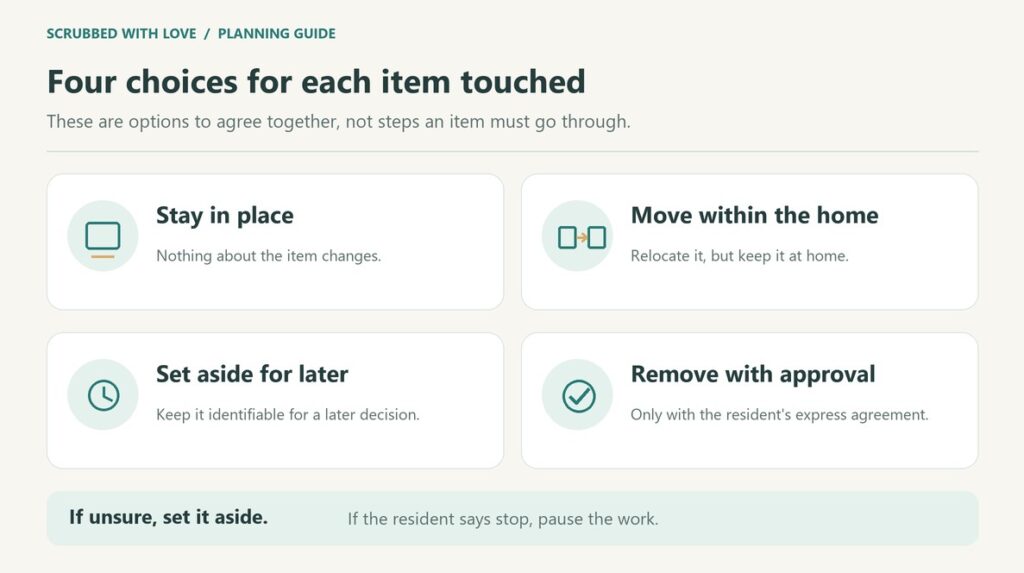
Every item touched during a first-stage visit ends up in one of four categories, and it helps enormously if everyone agrees on the categories before a single item is picked up:
The critical rule sits underneath all four: nothing moves to 'remove' without the resident's express, current agreement, not an assumption based on what a relative said, and not a decision made because an item 'obviously' has no value. Mind's guidance is explicit that professionals who understand hoarding should never make surprise visits or move things against someone's wishes.
Someone on the visit should be responsible for recording which category each item falls into, especially for anything set aside for later, otherwise 'later' quietly becomes 'never revisited.' And if the resident's agreement changes partway through (they become distressed, unsure, or simply say 'stop'), work on that category or area pauses immediately. A first-stage agreement isn't a one-off signature; it's a live understanding that can be renegotiated the moment it stops feeling right to the person whose home it is.
A well-planned first visit follows through on everything agreed beforehand, in a way the resident can see and check as it happens:
Scrubbed With Love's hoarder cleaning process begins with exactly this kind of structure: a confidential consultation, a discreet assessment visit, and a plan the resident approves before anything is touched, including the option of an unmarked vehicle for anyone concerned about discretion. Exact practice varies by provider and by job, so treat the list above as what to ask for and check against, whoever is doing the work, and use the agreement below to write the specifics down for this visit, this property, this resident.
A cleaning team's role is specific: making the physical space safer and more usable, with the resident's agreement, one stage at a time. It isn't a substitute for the kinds of support that address why the clutter built up, or for decisions that carry legal weight.
A few situations call for someone else to be involved, alongside or instead of a cleaning plan:
None of this is a cleaning company's decision to make, and a good one won't pretend otherwise. Clinical judgements, safeguarding assessments and legal questions about capacity or tenancy belong with the professionals trained to make them: the first-stage agreement is a planning tool, not a substitute for any of it.
A first stage isn't finished the moment the team packs up. Before anyone leaves, and again a little later, it's worth checking a few things properly:
This is also where it's worth being honest about what a single visit can't claim. One stage does not mean a home is 'safe,' 'fully sanitised' or permanently cleared: those are outcomes that depend on the resident's own pace and on what happens after this visit, not promises any single session can make. What a well-run first stage can genuinely deliver is a specific, agreed problem solved, trust maintained, and a clear-eyed view of what's left, which, for most residents and most homes, is a considerably better place to be than where things started.
This is a planning aid, not a legal consent form, a risk assessment, or a substitute for either. Use it to record what has been agreed for one visit, never to authorise anything by default.
For each item or area handled, record one of:
Signed / agreed by (resident): __________________ Date: __________________
Signed / agreed by (contractor or supporting professional, if applicable): __________________ Date: __________________
If you're weighing up a first stage for your own home, or for someone you're supporting, the honest starting point is a conversation, not a booking. Scrubbed With Love's hoarder cleaning team offers a confidential, no-obligation consultation specifically so the scope of any first visit can be worked out properly, after understanding the resident, the property and what actually needs to happen first, not before.
There's no fixed script for what a first stage should cover, and no cleaning visit can promise a home will end up 'safe' or fully sorted in one sitting. What a good first stage can offer is a properly agreed, properly bounded piece of work that respects the resident's pace, and the agreement above is there to help you plan exactly that, whoever ends up doing the work.