We’re the UK’s Go-To Cleaning Company
High-Standard Cleaning with Compassion and Care.
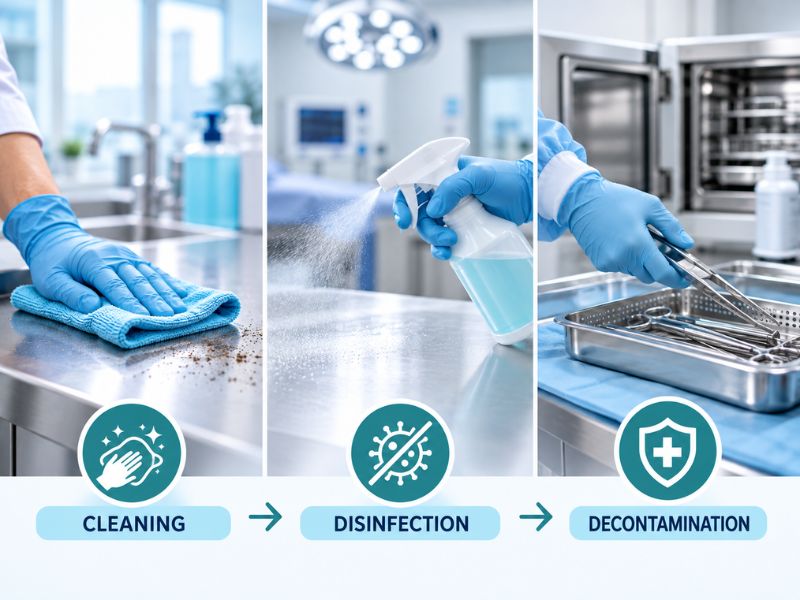
Quick answer: cleaning removes dirt, dust, and germs from surfaces using soap or detergent, but it does not kill what is left behind. Disinfection uses a chemical product to kill or inactivate harmful microorganisms, and it only works properly once surfaces have already been cleaned. Decontamination is the bigger job. It is the full process of making something safe again after contamination, and it can include cleaning, disinfection, and sometimes sterilisation. Surfaces can look spotless and still carry bacteria, viruses, or fungi. Visible cleanliness is not proof of safety.
Here is the short version if you only remember one thing:
The rest of this piece breaks down why that order matters, where people get it wrong, and why cleaning, disinfection, and decontamination each serve different purposes in infection control. What is the difference in practice? Read on.
Cleaning is the first step in almost every hygiene process. It physically removes dirt, dust, organic matter, and microorganisms from surfaces, usually with water, detergent, and some effort. Cleaning does not necessarily kill germs. Its job is removal, not destruction. Wipe a kitchen counter with soapy water, and you have done a good clean, but some bacteria will still be there. Fewer of them, spread thinner, but present. Regular cleaning removes most organisms along with the dirt they are sitting in, which is exactly why it always comes first. Removing that first layer of dirt is an essential step, not an optional one.
The UK cleaning, hygiene and waste industry is bigger than most people think. It contributes almost £72 billion to the UK economy and employs around 1.51 million people, roughly 1 in every 20 workers. There were approximately 78,915 businesses operating in the sector in 2025. That scale says cleaning is a serious part of protecting public health. Cleaning cannot eliminate everything on its own. That is exactly why the next two steps exist.
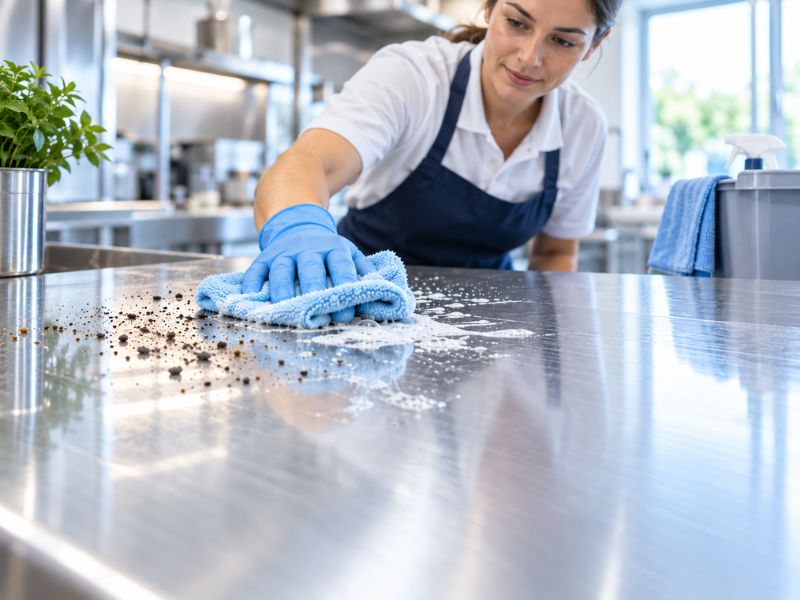
Cleaning equipment can itself spread contamination. A mop head used in three rooms without being rinsed does not clean the third room. It moves whatever was on the first surface onto the next one. Cloths, wipes, and cleaning solutions that get reused without proper care can transfer microorganisms from one surface to another rather than removing them. Regular cleaning only works if the tools stay clean too. This is one reason product labels on commercial cleaning chemicals include instructions on dilution, storage, and how often to change cloths. Even unopened, most cleaning chemicals have a shelf life worth checking before you trust them for a decontamination job. Poor technique undoes disinfection just as easily as it undoes cleaning.
Disinfection is different from cleaning. Disinfection is intended to inactivate or destroy harmful microorganisms on surfaces and equipment, not to remove dirt. Microbial contamination does not announce itself. A surface can look perfectly clean but still contain microorganisms, because visible cleanliness does not automatically mean a surface has been disinfected. Clean and disinfected are not interchangeable words. A worktop can be spotless to the eye and still need disinfecting if infection control requirements call for it.
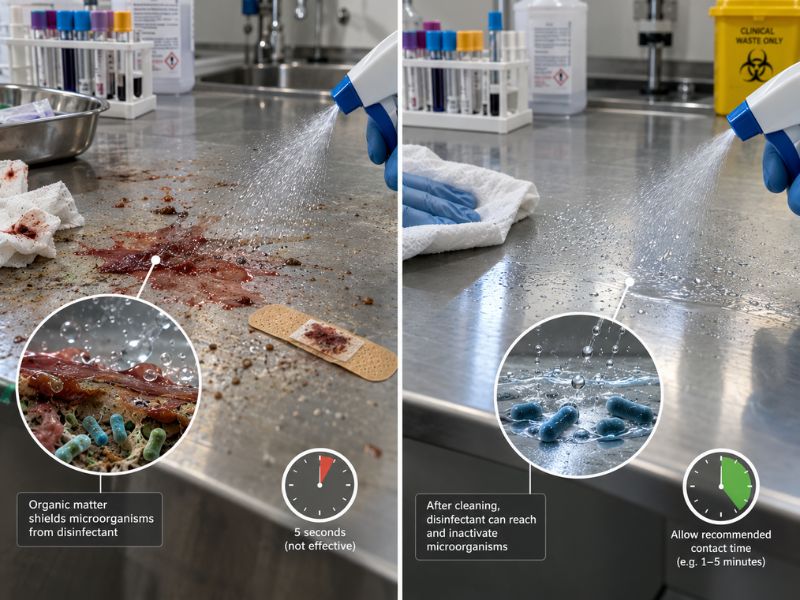
Disinfection does not remove dirt or physical contaminants. That is why cleaning should often come before disinfection. Dirt, blood, bodily fluids, and other organic matter can interfere with the effectiveness of some disinfectants, shielding the very microorganisms the chemical is meant to reach, which is exactly why disinfectants fail so often on surfaces that still show visible dirt. You disinfect surfaces after they are clean, never instead of cleaning them.
Most disinfectants fall into a handful of families, and not all disinfectants are equal: hospital-grade versions are tested more thoroughly than a supermarket spray. Sodium hypochlorite, for example, is the active ingredient in household bleach and is one of the most common. Sodium hypochlorite breaks down faster once diluted, which is part of why shelf life matters so much once a bottle has been opened, and why it pays to mix it in small batches rather than storing it diluted. Hydrogen peroxide is another option, along with quaternary ammonium compounds, often just called quats on a product label. Quaternary ammonium compounds are popular in commercial settings because they are gentler on soft furnishings than bleach, though they often need longer contact time to work. Chemical disinfectants and gentler alternatives both have a place, depending on the job. Each disinfectant has its own contact time requirement, meaning the number of minutes it needs to sit wet on surfaces before it actually works.
Disinfection does not usually eliminate bacterial spores. Spores are the tough, dormant form some bacteria take to survive harsh conditions, and most disinfectants cannot touch them. Even the best disinfectants fail if nobody reads the label. Killing spores needs a different level of process altogether, which is where sterilisation comes in, since ordinary disinfectants are not built for that job.
Look for proper registration on the label. In the US, this shows up as an EPA-registered disinfectant listing, while the UK and EU run their own equivalent registers, and not all disinfectants carry one. A disinfectant product carrying that kind of registration has been tested against specific bacteria, viruses, and fungi, and its label confirms the concentrated form should be diluted correctly before use. Ignore the instructions, and you get a weaker mix that struggles against the same harmful agents it is meant to remove.
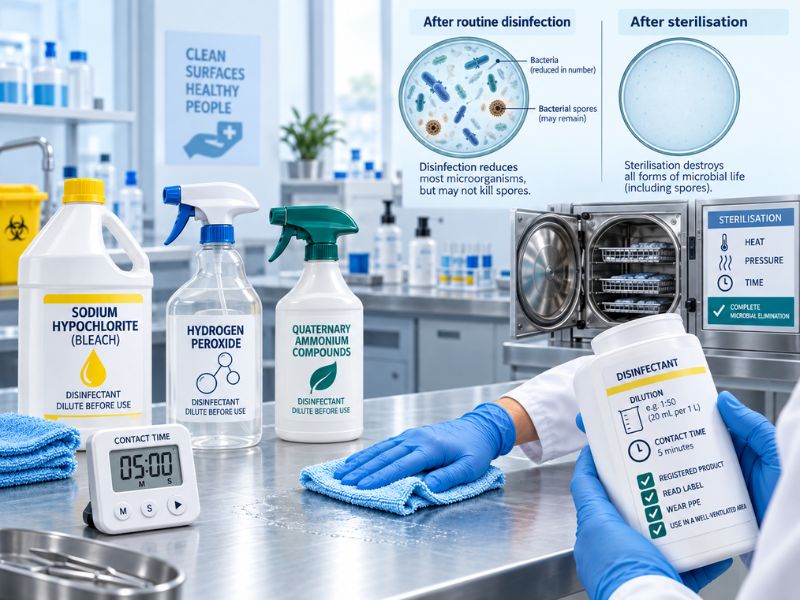
Decontamination is the broader term covering all of this. In a healthcare setting, cleaning, disinfection and sterilisation can all form part of the wider decontamination process. Decontamination is the process of removing or neutralising contaminants from a surface, an item, or an entire property, whether those contaminants are biological or hazardous substances such as chemical residue. The goal of decontamination is to make something safe to handle, use, or dispose of after contamination.
Outside hospitals, decontamination becomes essential in high-risk environments. Sewage escapes, chemical spills involving hazardous substances, and biohazard incidents involving blood or bodily fluids all fall under this umbrella. These jobs often need specialised equipment, personal protective equipment, the right chemicals for the job, and trained professionals, because the health risk is real and the regulations are specific. We choose disinfectants based on the risk involved, not habit or whatever is under the sink. Decontamination procedures for this kind of work are tightly controlled for exactly that reason. This is the biohazard cleaning work we handle at Scrubbed With Love, attending properties after incidents that go well beyond a normal clean.
Sterilisation goes further than disinfection. It is designed to destroy all microorganisms, including bacterial spores, and it is used for equipment that needs a higher level of microbial control, wiping out all microbial life. Surgical instruments and other medical devices are sterilised before every use in a healthcare setting, because there is no acceptable failure rate when something is going inside a patient's body. The same logic applies to a lot of medical equipment used in clinics and care homes, not just operating theatres.
Common sterilisation methods include heat, steam and specific chemical agents, such as hydrogen peroxide vapour for equipment too delicate for steam. Autoclaving, which uses pressurised steam, is one of the most common methods for laboratory equipment and surgical instruments. Ethylene oxide gas is used for medical devices that heat would damage. Sterilisation also matters in food processing equipment, where bacteria and fungi surviving on machinery can spoil an entire production run. None of this is overkill. It is matched to the level of risk involved.
This is the part people skip, and it is the part that matters most. Dirt, blood, bodily fluids, and other organic matter can physically block a disinfectant from reaching the microorganisms underneath. Removing dirt first is not a nice extra step; it is what makes the disinfectant afterwards actually work. Skipping that step can stop disinfection from working at all. A used plaster left on a worktop is a good example: wipe disinfectant over the top of it, and the germs trapped underneath never meet the chemical at all. A five-second spray does not kill bacteria the way a full contact time does.
In England's 2023 healthcare-associated infection survey, 7.6% of patients were identified as having a healthcare-associated infection. That is not a small number, and some of it comes down to sequencing: skipping the clean, rushing the disinfect, or treating a visibly dirty surface as if it were ready for the next step.
High-touch surfaces are exactly where this goes wrong most often. UK healthcare cleanliness standards flag high-touch surfaces such as door handles, light switches, call bells, bedside tables, and cot sides as areas needing particular attention. Healthcare equipment like trolleys, monitors, and shared devices sits in the same category. These get touched constantly, which means they get recontaminated constantly, so cleaning and disinfection on these spots need to happen on a proper schedule.
Every disinfectant has a required contact time, the length of time it must stay wet on a surface to actually kill what it is aimed at. Wipe it off too soon, and you have cleaned, not disinfected. Product labels state this clearly, usually somewhere between one and ten minutes depending on the chemical and the target organism. The effectiveness of any disinfectant depends on dose, contact time, and which surfaces are involved, not on how hard someone scrubs. Effectiveness is not something you can eyeball.
More disinfectant does not automatically mean better disinfection. The product must be used at its stated concentration, for its stated contact time, following its application instructions. That is true of household bleach as much as any hospital-grade disinfectant. Doubling the strength does not double the result. It just wastes chemical and, on some surfaces, causes damage.
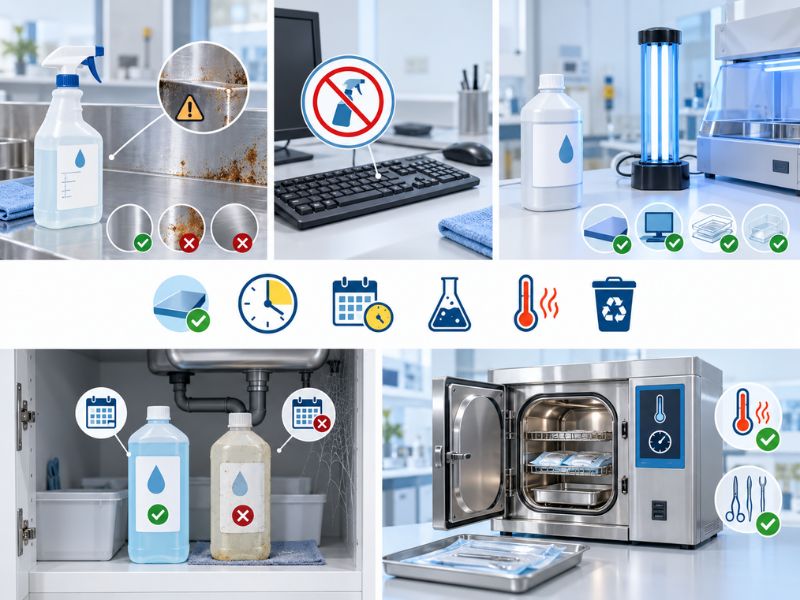
Surface compatibility matters just as much as contact time. Bleach can discolour fabric, corrode metal, and damage electronics such as computer keyboards. Hydrogen peroxide and UV radiation are sometimes used instead on equipment where bleach would cause more harm than good. Household bleach has a limited working life once diluted, so make it up fresh rather than storing it. Chemical disinfectants also have a limited shelf life once diluted or opened, so a bottle sitting under a sink for a year is not doing the job the label promises. Check the shelf life on anything that has been open a while.
Different decontamination methods suit different jobs. Heat works well for equipment that can handle it. Chemicals suit most everyday surfaces, and different chemicals suit different problems, so using the wrong one can do more harm than good. Quats often outlast bleach once mixed, which is worth knowing when choosing between them. Removal and disposal, covered next, suits situations where neither heat nor chemicals can be trusted to finish the job properly.
Not everything can be reliably disinfected. Soft, porous materials like carpet, upholstery, and mattresses soak liquid in rather than holding it on the surface, so a chemical cannot stay in contact with what it needs to reach. Intact skin is naturally resistant to a lot of harmful agents, but porous household materials offer no such protection.
Some pathogens make removal the only sensible option. Enveloped viruses tend to break down fairly fast outside the body, but others, including the hepatitis B virus, can survive on inanimate objects for days. Some viruses survive far longer outside the body than others, which is part of why blanket assumptions about safety are risky. Hepatitis B is one example: it is known for that kind of persistence, which is exactly why blood spill protocols treat it so seriously. When contamination has soaked into something that cannot be properly cleaned, disinfected, or sterilised, the safer call is usually to remove it, bag it, and dispose of it correctly. Removing contaminated material safely calls for personal protective equipment and correct disposal channels, not just bin bags and good intentions.
This is the judgement call at the centre of biohazard cleaning and trauma cleaning work. After a serious incident, a property might need contaminated carpet lifted, furniture removed, or an entire room stripped back before disinfection can even begin. It is also common ground with hoarding cases, where deep-set contamination and structural damage mean cleaning alone will never be enough. If you are dealing with either kind of situation, trauma and crime scene cleaning and hoarder cleaning both call for this same judgement, and go into more detail on how it plays out.
Professional biohazard cleaning in the UK typically costs anywhere from a few hundred pounds for a small, contained job up to several thousand pounds for widespread contamination across multiple rooms. The price is a rough guide, and the actual cost varies with the size of the area, the type of contamination, and how quickly access is needed.
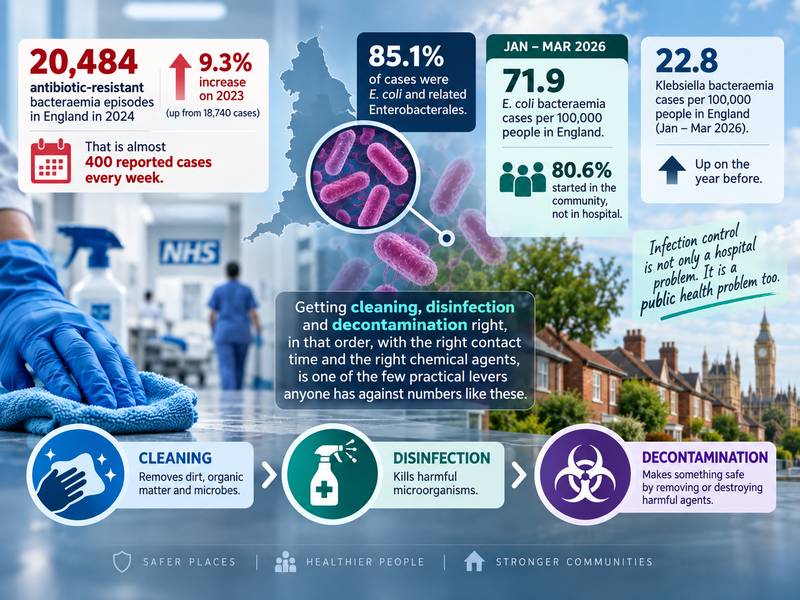
None of this is theoretical. England recorded 20,484 antibiotic-resistant bacteraemia episodes in 2024, almost 400 reported cases every week. That is a 9.3% increase on 2023, up from 18,740 cases. E. coli and related Enterobacterales accounted for 85.1% of those cases.
Between January and March 2026, England recorded 71.9 E. coli bacteraemia cases per 100,000 people, and 80.6% of them started in the community, not in hospital. Infection control is not only a hospital problem. It is a public health problem too. Klebsiella bacteraemia reached 22.8 cases per 100,000 people over the same period, up on the year before.
Getting cleaning, disinfection and decontamination right, in that order, with the right contact time and the right chemical agents, is one of the few practical levers anyone has against numbers like these.
A clean-looking surface is not proof of anything. The only way to know a decontamination process actually worked, following proper disinfection, is to check for evidence, not just appearance. Decontamination procedures without proper paperwork are just promises, and paperwork should always say which disinfectants were used. Treat decontamination as a complete process rather than a single wipe, and you will get results that hold up.
Professional teams verify effective decontamination through a few standard checks:
Good disinfection leaves a paper trail, not just a nice smell: which disinfectants were used, at what strength, and for how long. This kind of documentation is standard practice on biohazard and trauma jobs, where a family, landlord, or insurer needs proof the property is safe again, not just someone's word for it. That paperwork exists to prove the decontamination process was carried out correctly, not just claimed. Documentation is essential proof the job was done properly, not paperwork for its own sake. It is also why we always walk clients through exactly what was done and why, treating it as one complete process rather than a mystery, whether that is biohazard cleaning or any other job on a property.