
We’re the UK’s Go-To Cleaning Company
High-Standard Cleaning with Compassion and Care.
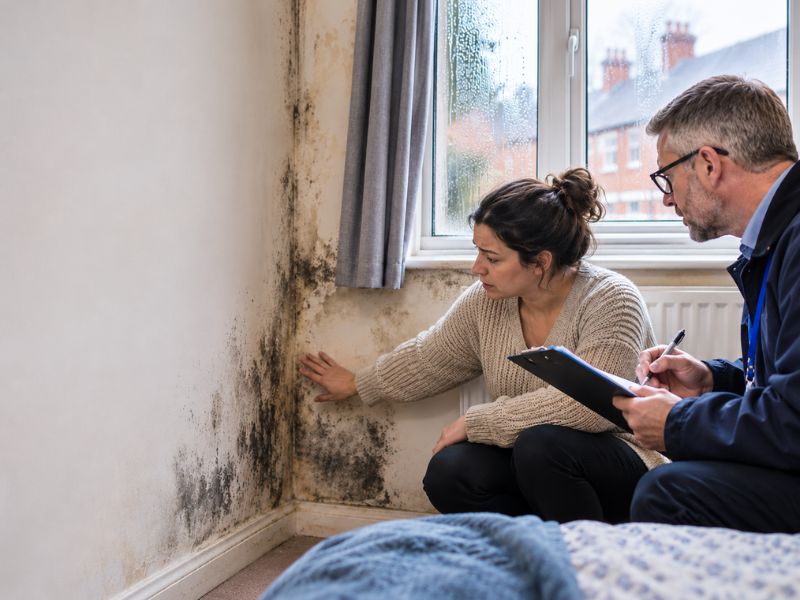
Awaab's Law is a set of rules that makes social landlords in England fix serious problems in rented homes by set deadlines. It came into force on 27 October 2025. Right now, Awaab's Law covers all emergency hazards plus significant damp and mould hazards.
Here are the numbers. Social landlords must investigate emergency hazards and make the home safe within 24 hours. For significant hazards, they must investigate within 10 working days. Then they have 5 working days to make the property safe. These strict timeframes apply to social housing in England only.
The rules do not yet cover the private rented sector. The government is now asking for views on how to extend Awaab's Law there. More hazards join Awaab's Law on 30 November 2026.
We wrote this guide for social landlords and social housing tenants who want the facts in plain English. Below, we cover what Awaab's Law requires, the deadlines, what tenants can do when a landlord fails, and what comes next.

Plenty of people mix up what this law does and who it protects. Let's clear that up first.
Awaab's Law is named after Awaab Ishak, a two-year-old boy who died in 2020. He had a severe breathing condition caused by prolonged exposure to mould in his family's social rented home in Rochdale. His parents had complained to their landlord many times over three years. The mould was never treated.
His parents then campaigned for change. That campaign led to Awaab's Law. The government calls it a legal backstop. Most landlords fix problems on time. Awaab's Law steps in for the ones who do not.
Three pieces of law do the work.
The Social Housing (Regulation) Act 2023 started it. It added a new term to the Landlord and Tenant Act 1985. That term gets written into every social housing tenancy agreement, so the landlord now has a contractual duty to follow the rules. Social housing tenancy agreements in England carry it by default. So every one of the social housing tenancy agreements signed by a council or a housing association now includes the duty, even if the paper contract never mentions it.
Next, the Hazards in Social Housing (Prescribed Requirements) (England) Regulations 2025 set out the detail, such as the deadlines. Then comes government guidance for social landlords. It explains how to apply the regulations. That guidance is not an official reading of the law, but it is the best map we have. These three parts make up Awaab's Law.
Here is why this matters. The deadlines now sit inside the tenancy. A tenant can take a landlord to court for missing them, because a breach of the Landlord and Tenant Act term is a breach of contract.
Awaab's Law applies to almost all social housing let under a tenancy by a registered provider. That means councils and housing associations signed up with the Regulator of Social Housing. It also covers temporary and supported housing when it is let under a tenancy. Awaab's Law sits in the social rented sector, the part of the market run by councils and housing associations. Other parts of the UK set their own housing laws.
Awaab's Law does not apply to homes let under a licence. It does not cover long leaseholders, owner-occupiers or shared ownership homes.
A hazard must also pass a few tests to count. It must come from a defect, disrepair or lack of maintenance. It must sit within the landlord's responsibility, such as the home itself, a garden or shared areas. The landlord must be able to fix it. And it must not be damage caused by the tenant breaking the tenancy agreement. We come back to that last point below.
Councils already use the Housing Health and Safety Rating System, known as HHSRS, to judge how safe a home is. It is a risk based tool that covers 29 types of hazard. Housing health checks under the system look at how likely a problem is and how bad the harm could be.
Awaab's Law borrows the language of that safety rating system, but it works differently. A landlord does not need to run a full assessment first. The hazard also does not need to reach category 1, the top band, to count. If a reasonable landlord would see a significant risk of harm, the clock runs.
The law uses two levels.
A significant hazard poses a significant risk of harm to the health or safety of someone living in the home. The rules define that as a risk a reasonable landlord, with the right knowledge, would fix as a matter of urgency.
An emergency hazard poses an imminent and significant risk of harm. That is a risk a reasonable landlord would make safe within 24 hours. A landlord must treat any significant or emergency hazard report as live from the moment it hears about it.
The guidance lists examples of emergency hazards. Think gas leaks and carbon monoxide leaks, a broken boiler, no water at all, exposed wiring, bad leaks, and broken external doors or windows that put home security at risk. It also names damp and mould that is hurting a tenant's health, and serious structural defects that could lead to structural collapse.
What a reasonable landlord does depends on who lives in the home. A broken window on a high floor is a bigger problem with a toddler in the flat. Landlords must account for age, health conditions and disability when they judge the risk. A tenant does not need a doctor's letter.
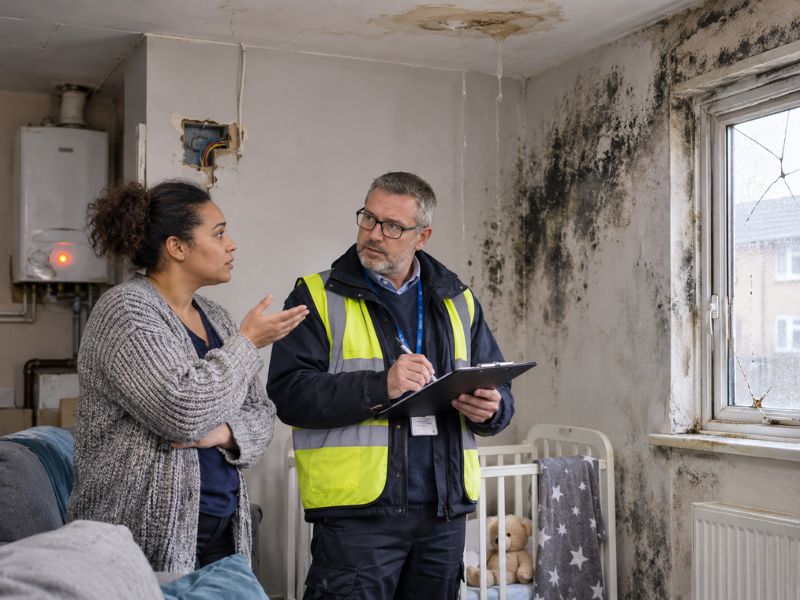
Emergency hazards and significant hazards sit on the same ladder. They are not the same rung.
Emergency hazards are the top rung. Under Awaab's Law, social landlords must investigate emergency hazards and make the home safe within 24 hours. There is no 10 working day wait. Emergency hazards also cover every kind of danger from day one, not just damp and mould. Gas leaks and carbon monoxide leaks sit on this rung. So do broken external doors that leave a home open to anyone.
Significant hazards get a longer clock, but they still carry a significant risk of harm. In the first phase, significant hazards under Awaab's Law cover damp and mould only. Social landlords get 10 working days to investigate. Then they get 5 working days to make the property safe. As Phases 2 and 3 land, significant hazards will cover a wider range of dangers.
How should a landlord pick the right tier? It asks one question. Is there an imminent and significant risk of harm, the kind a reasonable landlord would fix within 24 hours? If yes, it is one of the emergency hazards. If a reasonable landlord would fix it urgently, but not within a day, it is a significant hazard. When the answer is unclear, social landlords should treat the report as one of the potential emergency hazards until an investigation says otherwise. Guessing too low is the costly mistake.
Awaab's Law did not come from nowhere. The numbers show why.
Government housing survey data shows around 1.4 million homes in England had a recorded damp problem in 2024. That is roughly 5% of all homes. The rate changes a lot by tenure.
About 7% of social rented homes had recorded damp problems. Around 10% of privately rented homes did. For owner-occupied homes, it was about 4%.
Tenants report more problems than surveys record. Around 41% of social rented households said condensation, damp or mould was a problem in their home. In the private rented sector, the figure was about 46%. Among owner-occupiers, it was around 22%.
Understanding the difference between damp, condensation and mould can help tenants identify the causes of these problems and take the right steps to address them.
Serious condensation and mould affected roughly 3% of homes in 2024. In 2019, it was around 2%. So the problem is not shrinking.
Mould is not only a stain on the wall. Prolonged exposure to damp and mould can affect breathing and make asthma and allergies worse. Babies, young children, older people and anyone with a weak immune system face the biggest health risks.
That is why Awaab's Law talks about harm to a tenant's health and not just about repairs. Government guidance on damp and mould hazards makes the same point.
Damp and mould hazards sit at the centre of the first phase. So let's look at how the rules play out in a real home.
Not all damp and mould falls under the law. A little condensation on a window frame is usually a normal repair. Significant damp and mould hazards are different. They are problems that could seriously harm someone's health. Think widespread mould across walls and ceilings, mould in bedrooms, or damp that keeps coming back and hurts someone with a health condition.
Under Awaab's Law, mould hazards count as significant hazards once a reasonable landlord would see a significant risk of harm. So a landlord must treat significant damp and mould hazards as a priority, not as a routine job for next month. Mould from a leaking roof is the landlord's responsibility, and so is mould from a faulty extractor fan.
The guidance gives a good example. A tenant reports damp and mould throughout the home. Two adults live there and nobody has reported a health condition. The landlord treats it as a significant hazard. It investigates within 10 working days and books a mould wash to make the home safe within 5 working days. Then it keeps checking on the home while it deals with the cause.

Some cases cannot wait 10 working days. The guidance gives two. In the first, a pregnant tenant had breathing symptoms and the worst mould was in the only bedroom. In the second, mould in a child's bedroom was making the child's asthma worse.
In both cases, a reasonable landlord would see an imminent and significant risk of harm. So Awaab's Law treats both as emergency hazards. A report like the second one gives reasonable grounds for an emergency investigation on its own. The landlord must investigate and make the home safe within 24 hours.
Location matters here. Mould in bedrooms and living areas raises the risk, because that is where people sleep and spend most of their time. These are the significant damp and mould cases that move up to emergency hazards fastest.
Let's be blunt. A fresh coat of paint is not a fix. If the cause stays, the mould comes back.
Awaab's Law pushes landlords toward the root cause. That could be poor ventilation, missing insulation, a leaking roof, a failing damp proof course or a burst pipe. The guidance says that when a hazard comes from poor design or missing parts, the landlord must fix that. It gives the example of fitting mechanical ventilation or proper insulation. Mould and excess cold often travel together, because a cold wall invites condensation. Rain coming through failed windows or external doors can feed damp too. Landlords have to address hazards at the source.
There are two steps. First, relevant safety works make the home safe, such as a specialist mould wash or a dehumidifier. Second, preventative work stops the hazard from coming back. Landlords need both.
Social landlords cannot assume that mould comes from how a tenant lives. The guidance calls that unacceptable. Cooking, bathing, washing and drying laundry all add moisture to a home. Those everyday tasks are unlikely to count as a breach of the tenancy agreement.
Hazards caused by a tenant's own breach are a different story. Deliberate damage, blocking a ventilation fan, or taking out internal doors without consent can move a hazard outside Awaab's Law. Even then, the landlord still has other legal duties to keep the home safe.
The timescales are the heart of Awaab's Law. They are the longest a landlord is allowed to take. Social landlords can and should act faster when the situation needs it. Every significant or emergency hazard has its own clock. Think of the deadlines as a ceiling, not a target.
Here are the core strict timeframes:
Those six points are the core Awaab's Law requirements. Every other rule in this guide hangs off them.
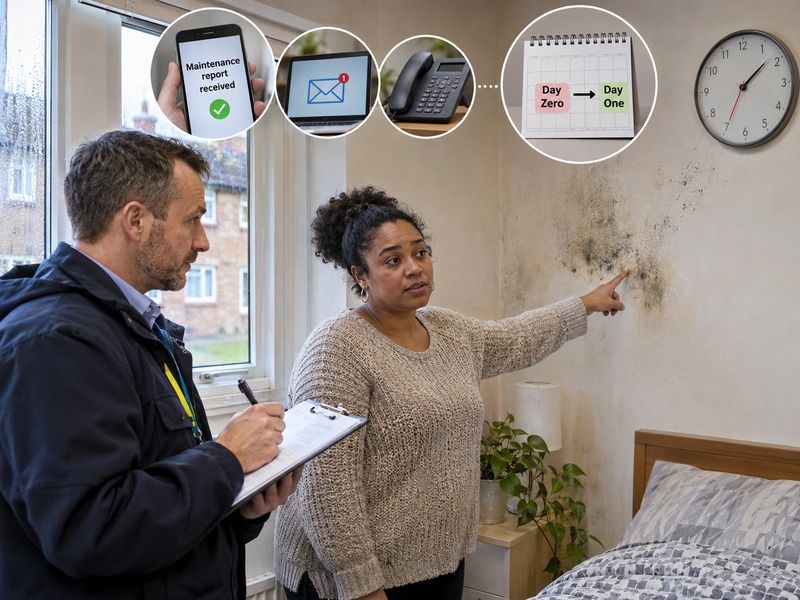
The clock starts when the landlord becomes aware of a potential hazard. That day is day zero. Day one is the next working day. A potential hazard does not need proof. A tenant only has to report a concern about a potential hazard, such as mould on a bedroom wall.
Awareness can come from many places. A tenant might tell a housing officer during a visit, ring the repairs line, send an email or write a letter. A neighbour, support worker or solicitor can raise it for the tenant. A contractor or the local housing authority can also pass it on.
If a tenant tells a managing agent or a council officer from another department, that likely counts as the landlord knowing. Social landlords cannot hide behind a broken reporting chain. When a third party reports the issue, the clock starts when the landlord is told, not when the third party first noticed. For emergency hazards, a delay in passing on the report can wipe out most of the 24 hours.
The law also covers older problems. If a landlord knew about a potential hazard before the rules began and someone reports a concern afterwards, the duty starts from that new report. A material change, like new symptoms or a worse hazard, restarts the clock. Until the facts are clear, a landlord should treat all potential emergency hazards as urgent. It should treat potential significant hazards as live too.
Awaab's Law sets four kinds of investigation, and each has its own rules.
A standard investigation must happen within 10 working days. It can be remote or in person. Photos or videos may be enough if they show the problem clearly. A competent person must carry it out. Its job is to identify hazards, confirm whether there is a significant or emergency hazard and, if possible, name the work needed.
An emergency investigation must happen within 24 hours when the landlord has reasonable grounds to believe there is an emergency hazard. The emergency investigation can also be remote, but some cases need a visit.
A renewed investigation applies when a tenant specifically requests an in person visit after a remote check. The landlord must then carry out a renewed in person investigation within 10 working days of the request. The timeline resets. Tenants who want an in person investigation should ask for one at the start. When a tenant requests a visit, landlords cannot say no.
A further investigation applies when the first check cannot find the cause. A structural survey is a common example. The landlord must still do the safety works while it waits for the survey. And if the tenant requests it, a further investigation must include an in person investigation of the home.
Landlords must keep investigation findings on record, whichever type they use.
Under Awaab's Law, the written summary must say whether the investigation found a significant or emergency hazard, and what the hazard is. If action is needed, it must set out that action and give target dates to start and finish the relevant safety works. If no action is needed, it must say so and give the reasons. It must also tell the tenant how to contact the landlord. It should repeat the investigation findings in plain words, not in technical terms.
Landlords send the written summary within 3 working days of the investigation concluding. They do not need to send one if all the work is done inside that window. They must still tell the tenant the work is finished.
The target dates in a summary are not legally binding. Even so, landlords must keep tenants updated, and a good written summary helps them show what they did if a case goes to the Ombudsman or a court.
Relevant safety works come first. These can include temporary measures, such as a dehumidifier, a mould wash, or portable heaters. Temporary measures must still make the home safe, not just look better. The landlord must then keep the home in that safe state until the preventative work is done.
The 12-week deadline does not replace the shorter deadline for making a significant hazard safe. It only covers the longer fix. And the landlord must still finish preventative work within a reasonable period, based on how urgent the problem is, what the tenant needs and how big the job is. The reasonable period shrinks as the risk grows.
For a significant hazard, that gives a simple rule of thumb. Up to 10 working days to investigate, plus up to 5 working days to make the property safe, comes to 15 working days at the longest. Landlords must act on significant hazards as soon as possible, so many should do far better than that. Emergency repairs, in particular, should not wait.
Sometimes the work cannot finish inside the deadline. The law has a plan for that.
If a landlord cannot make the property safe in time, Awaab's Law says it must arrange suitable alternative accommodation at its own cost. That covers everyone who normally lives in the home, including children who stay at least one night a week. The duty ends when the safety works are done. For emergency hazards, a family may need to move the same day.
Suitable alternative accommodation means more than a roof. The landlord must think about space, the distance to work and school, disability and medical needs, pets, and how long the stay will last. The guidance gives a clear example. A hotel might work for one night. It would not work for six weeks, because a family would have no kitchen.
Tenants can say no. They can stay with family or friends, or stay at home while the work is done. If they stay, the landlord must tell them what they can do to lower the risk. Social landlords and tenants should also agree on extra costs, such as transport and food. This is the one time temporary accommodation becomes part of a repair plan.

Picture a family of four in a two-bedroom flat. Mould has spread through both bedrooms and the repair will take three weeks. The landlord cannot make the property safe in the deadline. So it must offer suitable alternative accommodation with enough rooms and a working kitchen. A single hotel room fails that test.
Social landlords should plan for suitable alternative accommodation before they need it. A list of ready alternative accommodation, with room types and locations, saves days.
Awaab's Law gives social landlords one defence. They can show they used all reasonable endeavours to comply but could not, for reasons beyond their control.
Examples include waiting for approval from the Building Safety Regulator, being refused access to the home after many tries, or failing to find a specialist contractor or the right materials despite real effort. Courts decide whether the effort was enough.
The catch is proof. Landlords who cannot show records of calls, letters, visits and approval requests will struggle to use this defence.
Most social landlords, from councils to housing associations, already fix urgent repairs fast. The gap is usually in the process. Here is what we would check first to get ready for Awaab's Law if we ran a housing team.
Social landlords must judge risk using what they know, or should know, about the household. So they need up to date records of health conditions, disabilities, ages and contact preferences. A tenant does not need a particular vulnerability to be at risk from a hazard. Some hazards, like a gas leak, can hurt anyone.
Most reports start with a phone call. So the person who picks up is the first line of defence. Social landlords should train call handlers to spot emergency hazards on the spot. A good script asks simple questions. Is anyone ill? Is there a baby, a child or an older person in the home? Where is the mould? Do the external doors and windows lock? Can the family stay in the room safely tonight? Those questions help staff spot damp and mould hazards early.
If the answers point to emergency hazards, the case goes straight to an emergency investigation. No queue. No waiting for the next team meeting. Emergency repairs like a gas leak or a collapsed ceiling work the same way. The clock under Awaab's Law has already started, so every hour counts.
Staff should log every potential hazard, even a small one. Social housing providers should also test the process. Ring the repairs line yourself and see what happens. If a report takes two days to reach the right team, the deadline is already at risk.
Under Awaab's Law, a missing record can look like a missed deadline. Social landlords must keep accurate records of tenant communications and every investigation. Log the day of first contact, who took the call, what was said, when the visit took place, who attended, and what was found. Take photos before any work starts, and file them with the investigation findings. Log the date of any renewed investigation too. This protects tenants, and it protects landlords too.
Good records also feed the reasonable endeavours defence and help housing associations and councils answer a complaint quickly.
Social landlords stay responsible when contractors do the work. Housing officers, repair teams and agents all need to know how to pass a report on fast. Contractors must also know the deadlines and must tell the landlord about electrical hazards and other hazards they spot on a visit.
The implied term in the Landlord and Tenant Act sits with the landlord, not the contractor. That is why contracts need to match Awaab's Law. Social landlords should also review their social housing tenancy agreements and repair policies so they match the law.
Here is a short checklist for social landlords:
Social housing damp and mould is one of the biggest sources of complaints in the housing sector. Social housing landlords that treat damp complaints as routine risk ending up in front of the Ombudsman. The Housing Ombudsman figures show how big.

In 2025 to 2026, around 34% of repairs complaints investigated by the Housing Ombudsman were about condensation, damp and mould. More than 75% of the damp and mould complaints in the cases reviewed were upheld. About 8% of the findings were severe maladministration. Landlords were ordered to pay around £1.1 million in compensation in condensation, damp and mould cases that year.
Across all complaint types, the Housing Ombudsman recorded around 470 severe maladministration findings in 2025 to 2026.
Those figures show why repairs management, communication and record keeping matter. Ignoring repeat damp complaints does not just risk a bad outcome for the tenant. It can bring financial costs, reputational damage and formal complaints against housing associations and councils alike.
Across the whole social housing sector, the message is the same. Social landlords that log, triage and spot damp and mould hazards early do better with tenants and with the Ombudsman.
If you live in social housing and you are worried about mould or another hazard, here is the order we would follow. Social landlords must also keep you updated.
Tell your landlord in writing, by email or letter. Say what the hazard is, where it is, and how it affects your health or your family. Add photos and dates. If you have a health condition, a young child or an older person at home, say so. You do not have to supply medical evidence, although it can help.
If you ring, follow up with an email so you have a record. Keep every reply. Also note the day you reported it, because that is day zero. Awaab's Law starts counting from the day the landlord hears about it.
If you spot a potential hazard, report it early. You do not need to be sure it counts. Give clear details so the landlord has reasonable grounds to act. If you think you have a significant or emergency hazard, say so in your report. If you think it is one of the emergency hazards, say why, and ring as well as email. For emergency repairs, speed matters more than paperwork.
If a remote check does not help, ask for an in person investigation in writing. A renewed investigation resets the timeline, so ask for the visit early. If the landlord cannot fix the problem in time, ask about suitable alternative accommodation. The Awaab's Law requirements tell you what to expect at each step.
If the landlord misses an Awaab's Law deadline, make a formal complaint through its complaints procedure. The government encourages this route first, because it is faster and cheaper than court.
If the complaint does not fix things, or the landlord does not reply, you can take it to the Housing Ombudsman. The Housing Ombudsman can find maladministration when a landlord fails to follow Awaab's Law, and it can order compensation.
Because the deadlines sit inside the tenancy agreement, tenants can take legal action for breach of contract. Landlords face court action if they fail to comply with Awaab's Law. Before that, both sides are expected to follow the Pre-Action Protocol for Housing Conditions Claims. It pushes them to share information and try to settle early.
Awaab's Law is growing. The first phase focused on damp and mould and emergency hazards. The next ones bring in a wider range of hazards.
From 30 November 2026, seven more groups of hazards fall under Awaab's Law, where they pose a significant risk of harm. Social landlords will need a way to spot, rank and fix a wider range of problems. Social housing tenants will see the same deadlines apply to the new groups. Emergency hazards in those groups, such as live wiring, still need a 24 hour fix.
The new groups are excess cold, excess heat, falls (including on stairs and between levels), fire and explosions, electrical hazards, structural collapse (including falling parts of a building) and domestic hygiene (including pests and refuse).
Excess cold covers things like a broken heating system or a broken window in winter. Landlords will need to treat excess cold as a safety issue, not a comfort issue, once Phase 2 starts.
Excess heat falls into Phase 2 too, when a defect causes dangerous indoor temperatures. A top floor flat with no way to cool down shows how excess heat falls under Awaab's Law. Excess heat falls inside the new rules only when a fault causes it, not when the weather alone does.
Electrical hazards matter a lot here. Electrical hazards domestic tenants meet most often are exposed wiring, a faulty fuse board or broken sockets. Electrical hazards domestic landlords miss can start a fire, so they will now have clear deadlines.
Structural collapse covers cracked walls, failing ceilings and loose parts of a building. A structural collapse risk will usually need a further investigation, such as a survey. Falls, such as a broken stair rail, join the list as well.
The hygiene group also covers personal hygiene and food safety. A broken sink, a failed toilet or a rat problem can hit personal hygiene and food safety fast. Lacking a working kitchen hurts personal hygiene and food safety too.
The government plans a third phase in 2027. It will cover the remaining HHSRS hazards, excluding overcrowding, where they present a significant risk of harm. So the remaining HHSRS hazards, excluding overcrowding, will all be in scope within about a year. Phase 2 already covers structural collapse, so Phase 3 fills in the rest. Overcrowding stays out, which is why we say excluding overcrowding whenever we describe the final phase.
That makes Awaab's Law a broad housing safety framework, not just a mould law. Social landlords who build good habits now will find each phase easier. Each new phase of Awaab's Law works the same way, just with a wider range of hazards.
One thing stays outside the law. Awaab's Law does not cover cladding work.
Many tenants ask the same thing. Does Awaab's Law protect tenants who rent privately?
Not yet. Awaab's Law applies to social housing in England, not automatically to private landlords. The Renters' Rights Act 2025 gives the government the power to extend it, but that needs more regulations.
In October 2026 the government opened a consultation on how to extend Awaab's Law to the private rented sector. It closes on 18 December 2026. It will shape the hazards, the deadlines and the start date. The government says more than 5 million extra households could benefit.
The consultation also asks about temporary accommodation, care leavers' homes and supported housing. Those could take the total from about 4 million to around 9 million homes. The consultation covers a wider range of homes than the social sector alone. Landlords across the private housing sector will watch it closely.

Landlords in the private sector are not off the hook while they wait. They must already keep homes free of serious hazards. The Homes (Fitness for Human Habitation) Act 2018 requires a rented home to be fit to live in. Councils enforce the Housing Health and Safety Rating System, and they inspect for housing hazards. The Renters' Rights Act brought in fines of up to £7,000 for the most serious hazards. That is a maximum, not a typical penalty.
Around one in 10 private rented homes has a category 1 hazard, the most serious level. If you rent privately, report the problem in writing and contact your local housing authority if your landlord does nothing.
We are a cleaning business, so we see the clean-up side of social housing damp and mould work. We want to be honest about its limits.
The guidance itself lists a specialist mould wash and a dehumidifier as examples of safety work while a landlord looks for the root cause. A proper clean can make a room safer to live in while the bigger fix is arranged. Cleaning cannot fix emergency hazards such as a gas leak, though.
It is never the whole answer. If a leak, poor ventilation or missing insulation causes the mould, it returns. That is why Awaab's Law asks landlords to deal with the cause and not just the stain.
If you are a tenant, take photos before and after any clean. If you are a landlord or a contractor, record what was done, how, and when.
This guide comes from the Scrubbed With Love team. We wrote it to help social landlords and tenants understand a law that affects real homes. We are a cleaning business, not a law firm, so this is general information and not legal advice. For a case about your own home, speak to a solicitor, Shelter, Citizens Advice or your local council.
We checked the facts against official sources in November 2026, including the government guidance for social landlords, the government guidance for tenants in social housing, the Phase 2 announcement, the private rented sector consultation, and Housing Ombudsman data. Dates and rules can change, so check the latest guidance before you act.