We’re the UK’s Go-To Cleaning Company
High-Standard Cleaning with Compassion and Care.

Quick answer: A cluttered home becomes a health or biohazard risk when it stops people from living safely. The clearest signs include blocked exits, visible mould growth, pest activity, animal waste, strong odours, inaccessible toilets or kitchens, for example, and an inability to clean or move around safely. When clutter reaches this point, it is not a tidying problem. It is a health problem.
Most people picture hoarding as someone being a bit untidy. It is worth being clear about what hoarding actually involves before talking about the risks, especially when considering how to help a hoarder clean out their house. The reality is different. The NHS describes hoarding disorder as a mental health condition where a person collects lots of things and finds it very difficult to get rid of them, even when doing so affects their life significantly.
This is not about being messy. Hoarding disorder involves a persistent difficulty discarding items, and this is what separates hoarding from general untidiness., even ones with no practical use. A person affected by it may have a perceived need to save items that have no actual value to anyone else, or that others would discard without a second thought. The result of prolonged hoarding is that rooms fill up, living space shrinks, and everyday activities like cooking, washing, and sleeping become harder or impossible. The home environment changes in ways that create risk without any single dramatic moment.
Around 2.5% to 6% of people in the UK are thought to be affected by hoarding disorder or serious hoarding behaviours. Given the UK's population, that puts the scale of hoarding in the millions, and the health risks it creates on a corresponding scale. That is a significant issue affecting potentially millions of people, not a rare extreme.
Hoarding disorder sits close to obsessive compulsive disorder in clinical terms, and the two can overlap. The home environment shifts gradually, which is part of what makes it so hard to spot from the outside. It causes real distress to the person living with it and to family members around them. The condition is also closely linked to anxiety and depression, which is why mental health sits at the centre of any honest conversation about clutter, risk, and safety.
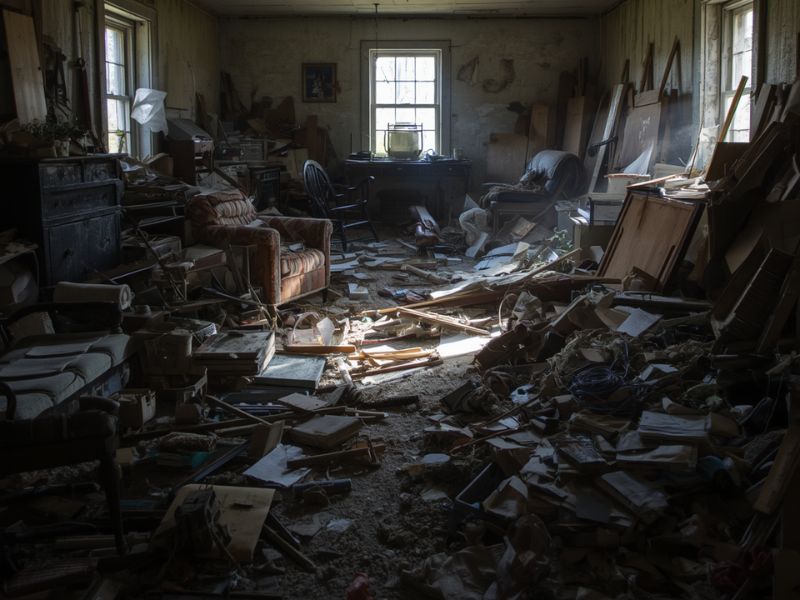
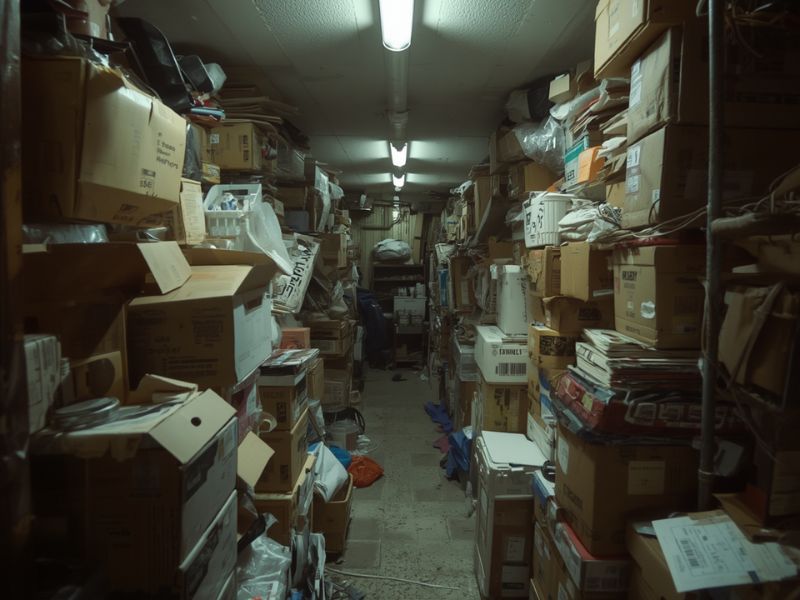
There is a real difference between a messy house and a home where the build up of stuff has created genuine risk, and this is often discussed in the context of hoarder cleaning vs decluttering. Take as an example a property where the hallway is stacked to the ceiling with boxes. That is not just untidy. It creates real risk. General clutter that makes a room look disorganised is one thing. Clutter that blocks exits, hides pest activity, traps moisture, or prevents safe use of the kitchen or bathroom is another entirely.
The key question is whether the home can still be used safely. When clutter makes it impossible to cook, clean, pay bills, sleep in a bed, or use a toilet, it has crossed from an inconvenience into a health hazard. That shift matters, because the risks involved are not small.
We see this in the properties we work in at Scrubbed With Love. The line is usually crossed when residents can no longer get to certain rooms at all, when strong smells are present throughout the property, or when there are visible signs of pest activity, water damage, or waste.
One of the most dangerous consequences of hoarding is the fire risk it creates. Hoarded materials, paper, cardboard, clothing and furniture all act as fuel. When these items fill hallways and block exits, evacuation becomes extremely difficult or impossible.
London Fire Brigade data shows how serious this has become. In 2025 alone, firefighters attended 1,028 fires involving hoarding in London, up from 954 in 2024. Since 2021, more than 970 people have been injured in hoarding-related fires. These are not near misses. They are injuries happening in real homes.
Cooking fires were the most common trigger. In 2025, 226 hoarding-related fires in London were caused by cooking. A further 137 were caused by items placed too close to heat sources. When clutter surrounds and covers a hob or oven, the fire hazard is immediate.
Blocked exits and piled combustible materials create conditions where emergency services cannot reach a person in time, and the person inside cannot get out. Fire safety in properties like these is not a theoretical concern. It is one of the most life-threatening aspects of severe hoarding.
The kitchen is often where risk concentrates fastest. Clutter around cooking equipment is a fire hazard in any home, but in a property where hoarding has taken hold, the risk multiplies. Grease, paper, textiles, cardboard and other flammable materials may sit within centimetres of a hob. There may be no clear space to put a hot pan down safely.
Significant fire risks also arise around electrical sockets when they are covered, blocked, or overloaded. Hoarded items piled against plug sockets or heaters are a frequent cause of fires in these environments.
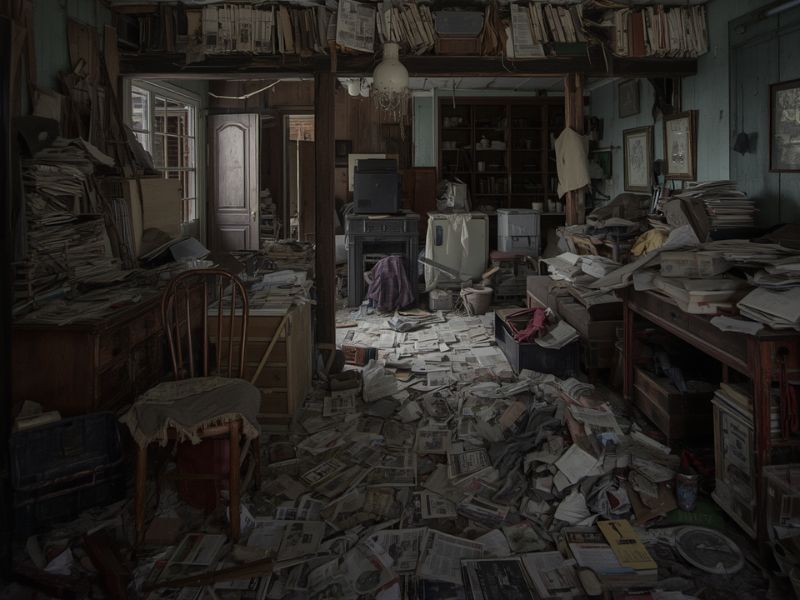
Clutter traps moisture. When air cannot circulate around furniture, walls, and floors in the home environment, condensation builds up and mould growth follows. In England in 2024, 1.4 million dwellings had a problem with damp, equal to roughly 5% of all homes. Among renters the rate was even higher, with 46% of private renters and 41% of social renters reporting condensation, damp or mould problems.
In a cluttered environment, mould can grow behind stacked items for months without being seen. By the time it becomes visible, it has often spread across a large area of wall or flooring. Mould growth causes respiratory issues including coughing, wheezing, and worsening asthma. For people with existing respiratory conditions, the effects on physical health can be severe, highlighting the dangers of mould in bedroom.
Poor air quality is a wider problem in these spaces. Dust mites build up in fabrics that are rarely moved or cleaned. Pet dander accumulates on soft surfaces. High levels of dust and allergens trapped by clutter worsen respiratory issues even without visible mould. The air quality in a heavily affected property is often measurably worse than in an organised environment.
This is a space problem as much as a hygiene one. When living space is reduced and air cannot move, the environment inside a property deteriorates even if there is no obvious mess on the surface.
Pest activity is one of the clearest signs that a property has moved from a health risk into biohazard territory. Cluttered spaces provide exactly the conditions pests need: warm hiding spots, food sources from decaying matter, and areas that are rarely disturbed.
In 2024, UK councils made 291,132 pest control visits to homes. Of those, 91% involved rodents. Rats were the leading pest recorded across the UK in 2025, accounting for 25% of pest activity, with mice close behind at 22%.
In a home where hoarding has taken hold, the signs to look for include:
Rodent droppings, urine, and contaminated dust are not just unpleasant. They carry genuine infection risk. UK public health guidance links rodents with leptospirosis and hantavirus, both of which can be transmitted through contact with infected urine, droppings, saliva, or contaminated dust. In 2023/24, there were 50 hospital admissions in England due to rat bites alone.
Clutter creates breeding grounds for pests. Once an infestation is established in a heavily hoarded property, clearing it safely requires professional equipment and protective measures that go well beyond ordinary pest control.
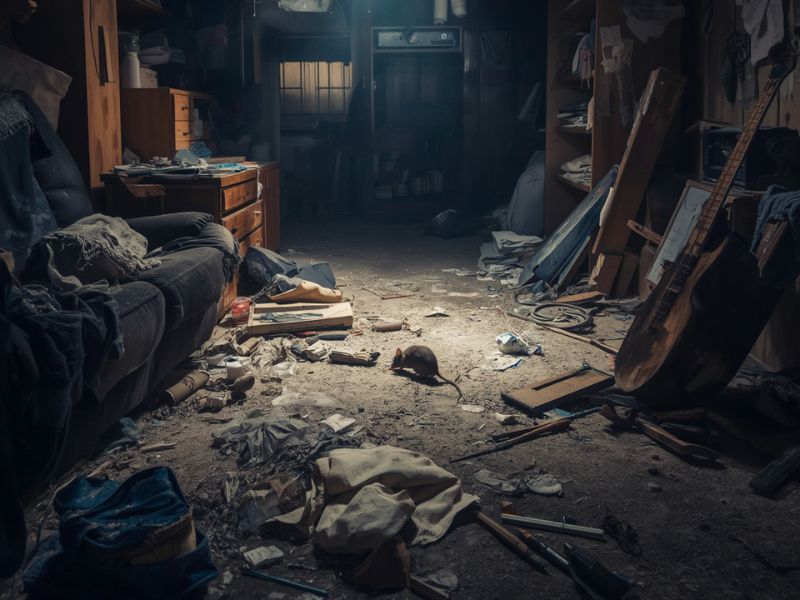
Animal waste in a property is a separate and more serious category of risk. When pets are present in a severely hoarded home, their waste can build up to a point where it contaminates flooring, seeps into subfloor materials, and creates an environment that is unsafe to enter without protective equipment.
Animal waste carries bacteria, parasites, and pathogens that pose direct health risks to anyone in the space. The same applies in rare but real cases involving human waste where sanitation has broken down entirely. At this point, the property is not a cleaning job. It is a biohazard clean.
We treat animal waste at Scrubbed With Love using full PPE and appropriate chemical treatments. The risks during cleaning of contaminated areas include airborne particles from dried waste, so the process requires more than a mop and bucket.
Heavy items stored in stacks create risk that is easy to overlook. Falling objects from overstuffed shelves or unstable piles are a serious injury risk, particularly in narrow walkways where there is no room to move out of the way quickly.
Beyond individual items falling, the structural integrity of a property can be affected by prolonged hoarding. Excess weight on floors, water ingress from undetected leaks hidden by clutter, and structural damage to walls and ceilings from persistent damp all contribute to a home that may not be safe to enter without assessment. Structural damage of this kind is expensive and takes time to develop, which is why early signs of damp and mould in such a home should not be left unaddressed.
In England in 2024, 2.3 million dwellings had a serious Category 1 housing hazard. Falls were among the most common of these, including falls on stairs, falls on the level, and falls between levels. Narrow pathways cluttered with items pose a real trip and fall risk. For older adults this is particularly dangerous. Around one in three people aged 65 and over fall at least once a year, rising to roughly half of those aged 80 and over. Unaddressed fall hazards in homes are estimated to cost the NHS in England £435 million annually.
The physical health risks of hoarding get a lot of attention. The mental health side is just as real and often just as serious.
A cluttered environment raises stress levels. Research consistently links living in disordered spaces with increased anxiety, depression, and mental fatigue. Clutter makes it harder to focus, harder to rest, and harder to feel in control of daily life. Sleep is disrupted when clutter fills the bedroom. Decision making becomes harder. The sense that there is so much stuff with no clear path through it can feel paralysing.
For people with hoarding disorder specifically, the disorder itself creates a cycle. The clutter causes anxiety. The anxiety makes it harder to act. The hoarding gets worse. The depression that often accompanies hoarding disorder makes it even more difficult to seek help or accept it from others.
Well being declines in ways that are not always visible from the outside, and the damage to a person's well being can be just as lasting as any physical injury. Social isolation is common. People affected by hoarding disorder often avoid inviting anyone to their home. They may withdraw from social interaction altogether because of shame or embarrassment. Friends and people close to them may not know how bad things have become. Support groups exist for both those affected and their loved one, and they can be a valuable part of recovery alongside practical hoarder cleaning and clearance work.
Physical and mental health are not separate in this context. Hoarding impacts both at once, and the combination places people at increased risk of chronic conditions, and both need to be addressed. Failing to deal with the health issues caused by hoarding means overall health continues to decline.
If you are supporting a loved one through this, knowing when to bring in specialist support matters. Practical clearance can remove the physical risk, but without addressing the underlying condition, the hoarding often returns.
A mental health professional with experience in hoarding disorder can work alongside a clearance team. This is particularly important in severe cases where the person has significant distress around the removal of items. Removing all that clutter without psychological support can cause real trauma.
If the person is experiencing significant distress, has shown persistent difficulty discarding items over many years, or is reluctant to engage with help at all, speaking to a GP or seeking a referral to a mental health professional is a meaningful step.
When clutter makes it impossible to maintain basic hygiene, the health risks build quickly. A kitchen that cannot be cleaned because of stacked items. A bathroom where the sink or toilet cannot be reached. Food stored improperly because the fridge is broken or the space around it is full.
Unsanitary conditions of this kind become breeding grounds for bacteria. The UK sees an estimated 2.4 million cases of foodborne illness every year at a cost of around £9 billion annually. A home where food preparation surfaces cannot be cleaned, where waste has built up, and where vermin have had access to food stores is a significant contributor to this risk.
Clutter also hides hazards that are not immediately obvious. Expired medications and leaking chemical substances tucked into stored goods can create chemical hazards. Sharp objects hidden under accumulated stuff become dangerous when someone tries to clear the space without knowing what is underneath.
Strong odours inside these spaces are rarely just unpleasant. A musty smell in every room, for example, is worth investigating rather than masking. A smell of ammonia often indicates rodent urine. A heavy musty smell points to mould. Decomposition smells indicate organic matter, whether food waste or organic matter, that has been left long enough to break down. These odours are indicators of the actual health hazards inside a property, not just signs that it needs a clean.

The scale of adult safeguarding concerns in England is significant. In 2024/25, there were 640,240 adult safeguarding concerns raised, up 4% on the previous year. The most common risk type in concluded enquiries was neglect and acts of omission, accounting for 40.8% of cases. The most common location was the person's own home, at 51.9%.
Hoarding that has reached a point where the person cannot clean, cook, or use their bathroom safely falls within the scope of self-neglect, which is a recognised safeguarding category, which is a recognised safeguarding category. In severe cases of hoarding where a person is at serious risk but refuses help, local councils have powers to intervene. Emergency services may be involved where risk to life is immediate.
For older adults especially, the combination of physical health problems, isolation, and hoarding disorder can create a situation where outside help is essential. Safety concerns of this level need more than good intentions from family members. They need a co-ordinated response.
A property that has reached biohazard level needs a different approach from a standard deep clean, and this is where understanding levels of hoarding & when to call a hoarder cleaning company becomes essential. At Scrubbed With Love, we are trained and equipped to work in hoarding environments that include contaminated waste, pest activity, mould, structural damage, and the full range of conditions described in this article.
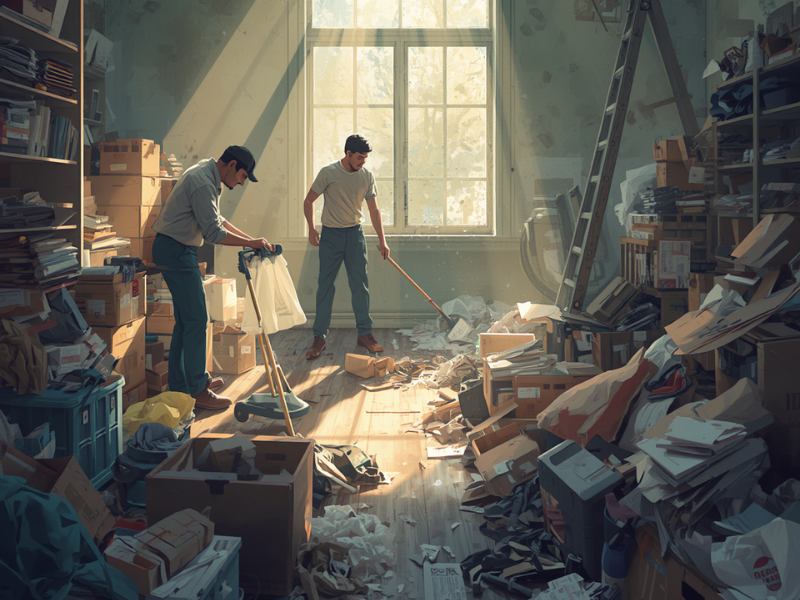
This kind of work involves full PPE, specialist cleaning agents, and a structured approach to clearing, cleaning, and treating affected surfaces. We work sensitively, knowing that the items in the space have meaning to someone. We do not throw everything away without care. We work alongside families, councils, and in some cases mental health professionals to make the process as supportive as possible.
We never suggest that a clean house is achievable overnight, or that clearing the space solves everything. Less clutter is a start. A safe environment is the goal. Addressing what caused the clutter to accumulate in the first place is the long-term work.
If you are concerned about a loved one, or about a property you are responsible for, getting professional help sooner rather than later reduces both the cost and the risk involved. An organized environment is achievable. Clutter does not define a person or a home permanently, but the earlier the intervention, the better the outcome for everyone involved.
It helps to know what to look for, especially if you are worried about someone you care about. These are the signs to watch for:
Any one of these signs suggests the home environment has reached a point where specialist support is needed. Several together indicate a situation where the response goes well beyond encouragement to tidy up.
Hoarding disorder is a recognised mental health condition. The person living with it is not lazy or uncaring. Hoarding is a recognised condition, and they are dealing with something that makes it genuinely hard to change without support. Understanding that makes it easier to offer help in a way that does not push people further into the social isolation that so many people with hoarding disorder already experience.
At Scrubbed With Love, we work in these environments every day. We know what the risks look like. We know how to clear and clean them safely. And we know that the people inside these homes deserve to be treated with respect throughout the process.
Scrubbed With Love provides professional biohazard cleaning, hoarding clearance, and specialist deep cleaning services across Liverpool & Manchester and the surrounding areas.