We’re the UK’s Go-To Cleaning Company
High-Standard Cleaning with Compassion and Care.
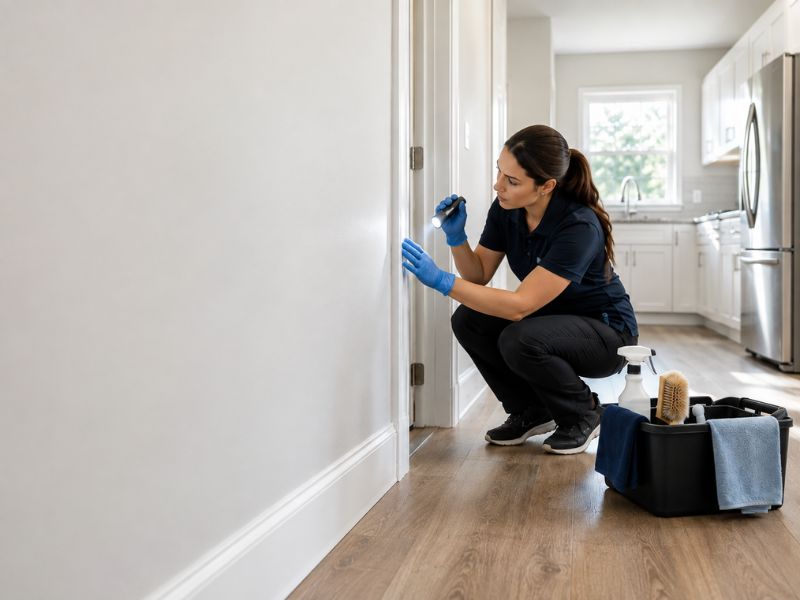
A rental property can look clean from the doorway and still contain problems that only surface once somebody opens the cupboards, cleans the appliance seals, gets in behind the radiators and works around the bathroom edges. For landlords, the void between tenancies is therefore more than a cleaning window. It is one of the best opportunities in the whole tenancy cycle to notice small problems before a new tenant moves in.
Scrubbed With Love is a North West cleaning company working with landlords, tenants and property professionals on end-of-tenancy cleaning, deep cleaning and specialist cleaning. This article sets out, in full detail, what that close-up view tends to reveal, why it matters legally and financially, and where a cleaner's role stops and a qualified professional's begins.
Clear worktops and vacuum lines create an impression of readiness. They say nothing about what is happening inside a cupboard, behind an appliance or under a sink. Cleaning is also the single most common reason tenancy deposits get contested, and the scale of that is worth setting out properly.
The Deposit Protection Service reported that cleaning accounted for 29.38% of its deposit claims in 2025, up from 24.57% in 2021, making it the leading claim reason for the fifth year running. Damage followed at 18.42%, rent arrears at 16.45% and redecoration at 10.88%. DPS is also clear that fewer than 5% of the deposits it protects end in a dispute at all, so a high claim-reason share is not the same as most tenancies ending in conflict.
The Tenancy Deposit Scheme's 2025 statistical briefing recorded 46,950 formal adjudications across England and Wales in 2024 to 2025, around 1% of all protected deposits. Cleaning appeared in 54% of those formal disputes, damage in 49%, redecoration in 31%, gardening in 14% and rent arrears in 10%. That 54% describes the minority of cases that reach adjudication, not the outcome of a typical tenancy, and the two schemes use different denominators, so the figures should not be blended into a single statistic. The more useful point for landlords is not the dispute percentage itself but what it points to: cleaning is where attention is already concentrated at the end of a tenancy, and a genuinely close clean can reveal far more than deposit-worthy grime.
TDS guidance is also worth stating plainly, because it gets misunderstood on both sides of a tenancy. As a general rule a property should be returned to the same standard of cleanliness recorded at check-in, and the check-in and check-out reports are the central evidence in any dispute. A landlord cannot require a tenant to use a particular professional cleaning company, and the Tenant Fees Act 2019 framework restricts what can be charged as a condition of tenancy, so a professional clean cannot simply be imposed as a mandatory third-party fee. None of this means professional cleaning is worthless. It means the value of a professional clean at turnover is not the deposit argument. It is what the clean reveals.
A landlord walkthrough is usually a visual pass through a furnished or recently vacated space, often completed in minutes. A professional clean is different in kind. It involves opening cupboards, wiping seals, clearing filters, working at floor level, reaching behind radiators, cleaning window frames and spending sustained time in kitchens and bathrooms rather than a brief look around each room. That difference in viewpoint, not any special expertise in diagnosis, is what surfaces the detail a walkthrough misses.
The pattern reported by cleaners working on rental properties is consistent. The problems that surprise landlords most are rarely in the middle of a room. They are behind and underneath appliances, inside cupboards and under sinks, in appliance seals and filters, around bathroom silicone and extractor fans, and in the gaps behind furniture, radiators and window frames. The boundary matters as much as the observation. A cleaner can see and report what is in front of them. Diagnosing the cause of damp, assessing an electrical fault, identifying a pest species or determining structural safety is a job for the landlord and the relevant qualified trade, not the cleaning team.
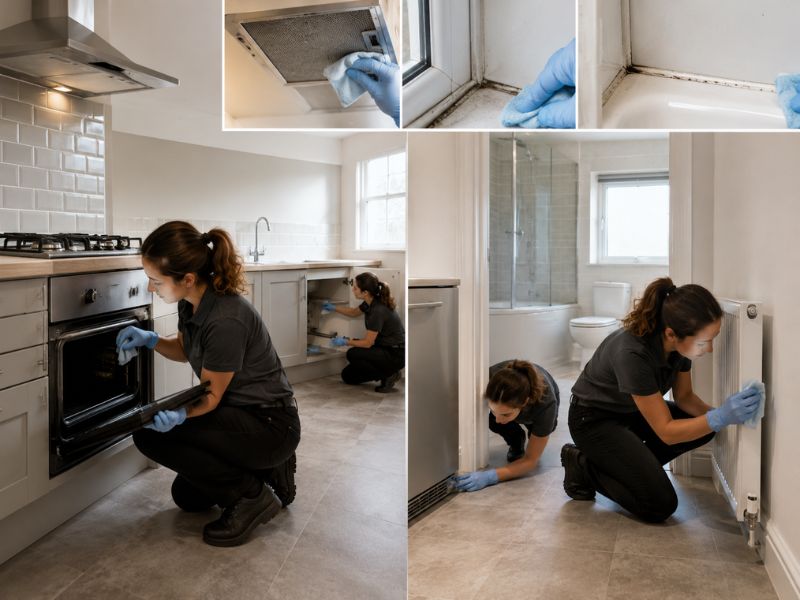
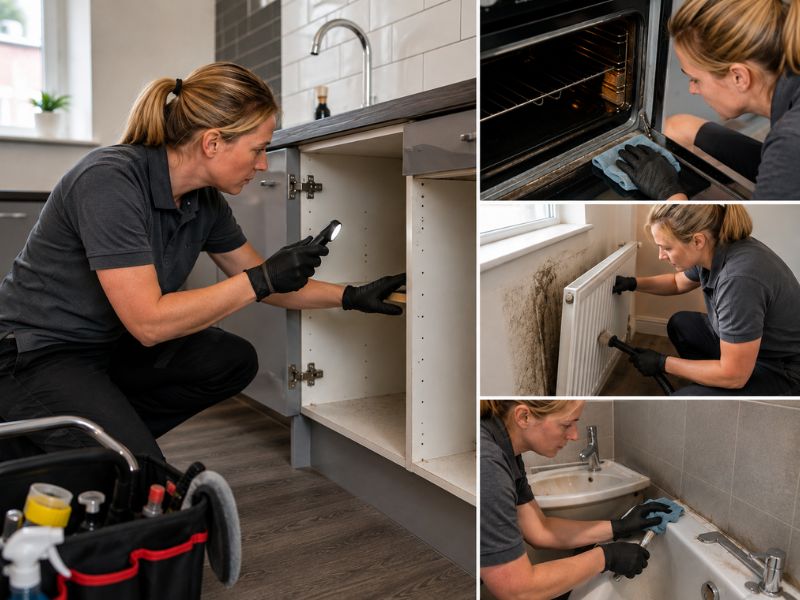
Kitchens generate the most hidden labour of any room in a property, because grease, food residue, appliances, cupboards, filters and plumbing all sit in one space. Ovens are the obvious problem, because baked-on grease is genuinely difficult to remove and is usually what a tenant leaves behind. But washing machine rubber seals and detergent drawers, dishwasher filters and seals, extractor grilles, the tops and insides of cupboards, and the space behind appliances are just as likely to hold the real story, and they are the areas that separate a quick tidy from a genuine end-of-tenancy clean. Externally, a washing machine or dishwasher can look perfectly clean while the seal, drawer, filter or internal edges are still holding mould, detergent residue, hair or food debris.
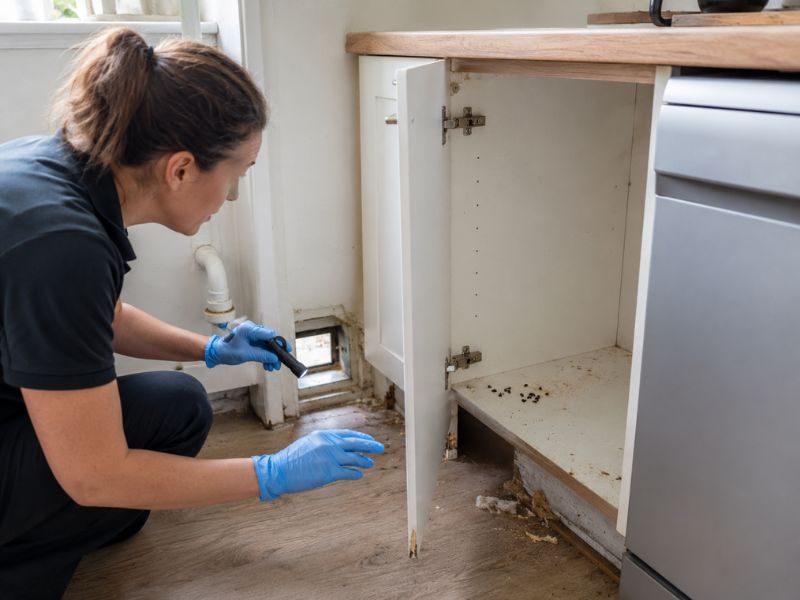
Maintenance clues worth flagging to a landlord include staining, swelling or active moisture under a sink, damaged cupboard board, mould that keeps returning to the same spot, and an extractor that is heavily clogged or does not appear to be working. Food and pest clues include crumbs and old food behind units, droppings, dead insects, gnaw marks, nesting material or an unusual smell, particularly around kitchens, cupboards and the space behind units. A cleaner can report what they see. Identifying a pest species, or fixing a plumbing connection, is not their role, and a pest control professional should identify and treat an infestation where necessary.
There is a narrow but genuine safety point worth making about kitchen and utility appliances. The London Fire Brigade advises cleaning a tumble dryer's lint filter after every load, and its investigation into a hostel fire in Bloomsbury on 8 February 2025 found the accidental cause was lint build-up in a tumble dryer. That single incident sits inside a wider pattern. Electrical Safety First's analysis of Home Office fire data found 1,140 accidental electrical fires involving white goods, tumble dryers, washing machines, fridge freezers, dishwashers and washer-dryer combinations, occurred across England in a single recent year, roughly three fires a day, with washing machine fires specifically up 7% year on year in that dataset. None of this means every dusty filter is an imminent fire. It does mean a filter, a seal or a vent behind an appliance is not purely cosmetic, and a cleaner flagging a badly clogged filter is passing on a genuinely useful observation, not being alarmist.
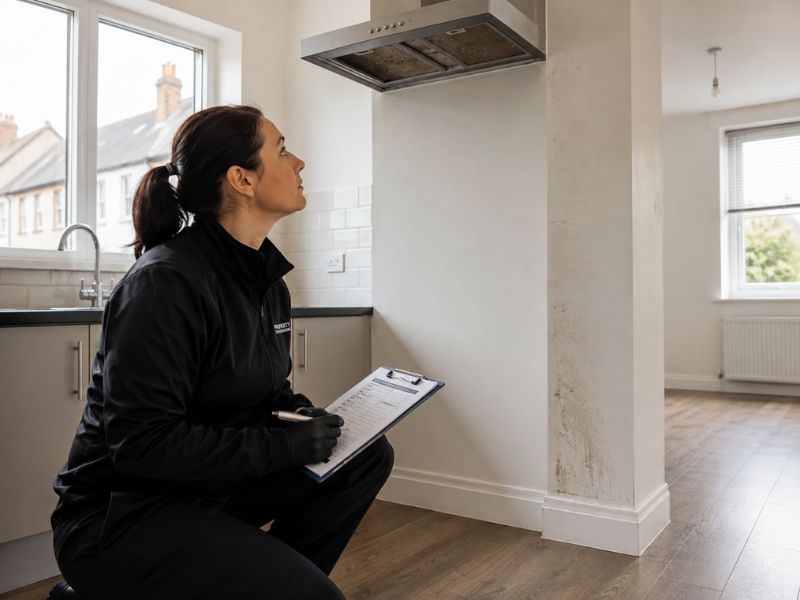
Bathrooms combine limescale, soap residue, mould, grout, silicone and extraction, often all needing attention at once, which is why they are usually the second largest source of hidden labour after the kitchen. Failed or missing sealant, staining around baths and showers, repeated mould, and a grille clogged with dust or grease are the details worth a landlord's attention, because current government guidance on damp and mould treats visible mould, mould odour, water damage and condensation as observable evidence that the issue needs remedying. Cleaning mould off a surface is not the same as fixing the reason moisture is accumulating there in the first place, and a bathroom is usually the room where that distinction matters most, because it is also the room generating the most moisture on a daily basis.
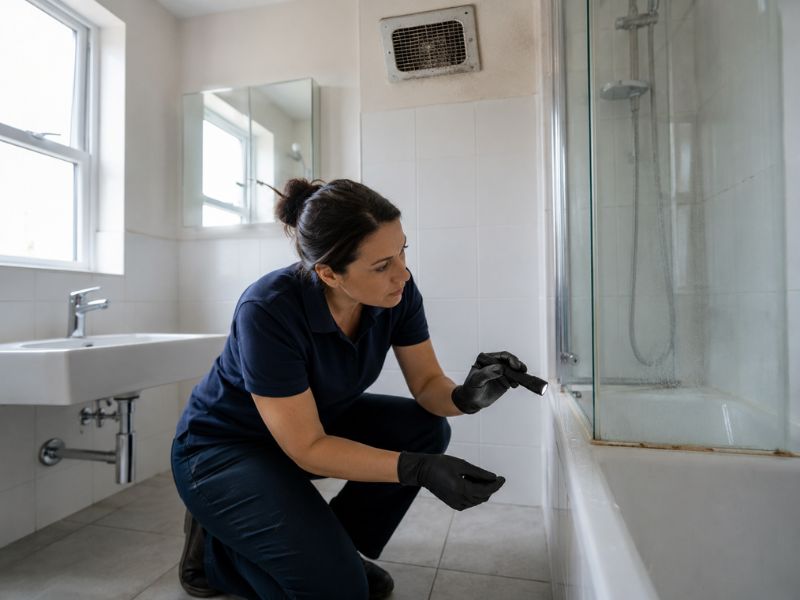
Damp is not a minor or occasional issue in the private rented sector, and the scale of it is worth setting out with current figures rather than relying on impression. The English Housing Survey 2024 to 2025 found a damp problem in 10% of private rented dwellings, against 7% of social rented and 4% of owner-occupied homes, with serious condensation present in around 6% of private rented dwellings specifically. The same survey found that 2.3 million dwellings in England, 9% of the total stock, had a Category 1 hazard under the Housing Health and Safety Rating System, and that private renters were the group most likely to be living in a home that failed the current Decent Homes Standard altogether, at 22%, compared with 14% for owner occupiers. Among households with dependent children in the private rented sector specifically, the survey found 14% were living in a home with a damp problem, which is one of the clearer indicators of why this matters beyond property condition alone.
It helps to understand why damp carries legal weight rather than just being an inconvenience. The Housing Health and Safety Rating System, introduced under the Housing Act 2004 and in force since 2006, assesses 29 potential hazards in a home, including damp and mould growth, and scores each one by the likely harm to an occupier. Hazards scoring in the most serious bands are classed as Category 1, and where a local authority identifies a Category 1 hazard it has a legal duty to take enforcement action against the landlord. Damp and mould is one of the most commonly cited Category 1 hazards nationally, alongside excess cold and electrical and fire risks, which is part of why the government has treated it as a priority area for reform.
Liverpool City Council describes damp and mould as a common problem in privately rented homes in the city, and is explicit that persistent damp and mould cannot simply be blamed on a tenant's lifestyle. Everyday activity produces moisture, but government guidance points to building deficiencies, inadequate or blocked ventilation, cold surfaces and poor insulation, ineffective heating, leaks and condensation as the causes landlords need to investigate. Liverpool's own guidance lists penetrating damp causes such as damaged roofing, guttering or downpipes, leaking plumbing, and cracks or holes in brickwork or pointing, as the kind of building-side issues that sit behind a recurring problem.
Cleaners see the same issue from a practical angle: mould behind furniture pushed against an external wall, around window reveals, inside wardrobes, on bathroom silicone, near extractors and inside washing machine seals. Sometimes the first clue is a musty smell rather than a visible black patch. If mould keeps coming back to the same spot, that is a signal to look for the source of the moisture, not to clean harder. Government guidance is direct on this point: removing surface mould will not prevent recurrence, and landlords should identify and address the underlying cause. Larger mould occurrences may need professional removal, and government guidance says specialist hygiene or cleaning services may be appropriate depending on severity, which is one of the reasons a company with both routine and specialist cleaning capability is useful to a landlord managing a portfolio.
It is worth landlords being aware of where the regulatory direction of travel is heading here, without overstating what is already confirmed. Awaab's Law, named after two-year-old Awaab Ishak who died in 2020 after prolonged exposure to mould in a social housing flat in Rochdale, came into force for social landlords on 27 October 2025, setting fixed statutory timeframes for investigating and fixing damp, mould and emergency hazards. Government guidance for social landlords confirms a second phase is planned during 2026 to add hazards including excess cold and heat, fire, electrical safety and hygiene, with a third phase covering the remaining HHSRS hazards from 2027. The Renters' Rights Act 2025, which received Royal Assent on the same day, gives the government the power to extend equivalent duties to private landlords in England, and a reformed Decent Homes Standard for the private rented sector is part of the same reform package. As of the research date for this article, the government's own implementation roadmap has not set a confirmed commencement date for extending Awaab's Law itself to private landlords, and separate government analysis has indicated the private rented sector Decent Homes Standard is not expected to take effect until 2035. Landlords should treat this as a direction of travel rather than a live private-sector deadline, and check current GOV.UK guidance before relying on any specific date circulating online.
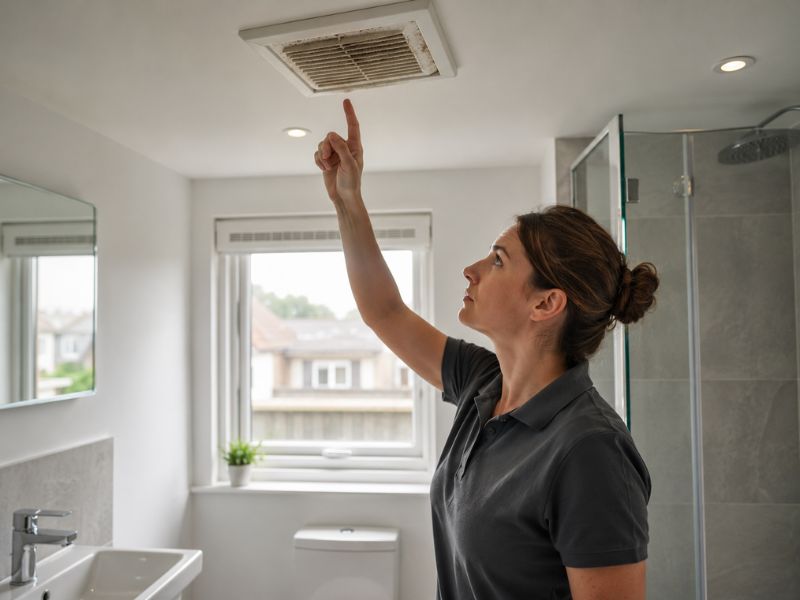
Kitchens and bathrooms are moisture-heavy rooms, and government guidance is clear that they need adequate ventilation. Extractor fans should be inspected and maintained by qualified professionals, and guidance specifically lists damaged, blocked, absent or switched-off mechanical ventilation as a risk factor worth investigating. Trickle vents should be free of blockages, and leaving a gap between furniture and an external wall can help airflow where space allows. A cleaner can flag a grille coated in dust and grease, or a fan that does not seem to be pulling air. They are not certifying that the system meets its rated performance, which requires proper testing.
Emptying and wiping a cupboard that has sat closed for a tenancy is often the point at which swelling, staining, mould or pest evidence becomes visible for the first time since move-in. Liverpool's own landlord guidance sets a useful baseline here: drains should be free of blockages and leaks, extraction should be in good working order, kitchen cupboards, doors and food-preparation surfaces should be in good repair, and there should be no obvious pest entry points. Cleaning inside a cupboard sometimes exposes evidence that a five-minute inspection does not, simply because the inspection never involves emptying it.
Mould and condensation on window frames, blocked trickle vents, mould behind wardrobes or sofas pushed against external walls, and debris behind radiators are all things a close clean brings into view. Government guidance notes that a mould odour without visible growth can indicate mould concealed behind wallpaper, under carpet, or behind pipes, furniture or ventilation units. If that is suspected, the correct response is to investigate properly, not to disturb the area during a routine clean, since disturbing concealed mould without the right controls can spread spores rather than resolve the problem.
Cleaners spend hours in a property, long enough for a persistent smell to register even after the initial walkthrough has finished. Mustiness or mould, stale smoke, pet urine, drains, spoiled food or other contamination are all things a nose picks up before an eye does. A smell that persists after ordinary cleaning suggests the source has not been dealt with. It does not, on its own, identify what that source is, and it should be reported as exactly that: a persistent odour worth investigating, not a confirmed diagnosis.
Pest evidence during a turnover clean is not rare, and it is worth landlords understanding the scale rather than assuming it is unusual. Older but still widely cited research from Shelter, summarised in a House of Commons Library briefing, estimated that nearly half a million private rented homes in England, around one in nine, had problems with animal infestation. More recent polling of landlords, tenants and agents by the Tenancy Deposit Scheme found mouse infestations were the most commonly identified pest issue at 47% of respondents, followed by rats at 39%, with the remainder split across wasps, fleas, bed bugs and cockroaches. Pest infestation also sits within the HHSRS hazard list, under the domestic hygiene, pests and refuse category, and can be treated as a Category 1 hazard where the risk is severe enough.
The clues a cleaner is likely to encounter during a property turnover include droppings, dead insects, gnaw marks, nesting material, contaminated food residue or an unusual smell, particularly around kitchens, cupboards and the spaces behind units. A cleaner can report the evidence. A pest-control professional should identify the species and carry out treatment where necessary, and a landlord should establish whether the entry point is a structural issue, such as a gap around pipework or a damaged airbrick, since treating the pest without addressing the entry point usually means the problem returns.
From 1 May 2026, tenants in relevant assured tenancies gained the right to request permission to keep a pet, and landlords cannot unreasonably refuse under the Renters' Rights Act 2025 reforms, with any refusal needing to be considered on a case-by-case basis. For turnover cleaning, that may mean more attention to pet hair in filters and edges, odour, staining or scratched finishes at the end of some tenancies. That is a cleaning and, occasionally, a damage question. It says nothing about whether a tenant has kept a pet responsibly, and it should not be treated as though it does. The same close-clean principle applies here as everywhere else in this article: report what is actually found, and do not assume a pattern that is not there.
Most turnovers are routine. Occasionally the environment presents a different risk profile entirely: sharps or needles, significant bodily fluids, human or animal waste, badly decomposed material, heavy pest contamination, severe hoarding, extensive mould, unknown hazardous substances or unsafe structural conditions. In those cases the correct response is not to clean harder. It is to stop, reassess, and bring in the right specialist process, protective equipment and waste route. If a needle or other sharp is found on what was expected to be an ordinary end-of-tenancy clean, it should not be treated like normal rubbish, because the risk assessment and disposal requirements change entirely.
This is why specialist services such as biohazard cleaning, hoarder cleaning, house clearance and needle sweeps exist as a distinct category from a standard end-of-tenancy clean, rather than an extension of it. Scrubbed With Love's own specialist scope covers exactly this boundary, including biohazard cleaning, hoarder cleaning and needle sweeps, which is the practical link between an ordinary turnover clean and the point at which a job needs to be reclassified. These scenarios are escalation examples, not a description of what a typical turnover clean involves, and nothing here should be read as claiming any specific incident on any specific job unless that has been separately confirmed.
An empty property is also the point at which several landlord obligations are easiest to check, and it is worth landlords treating the void period as a compliance window as much as a cleaning window.
Electrical installations in rented properties in England must be inspected and tested by a qualified person at least every five years under the Electrical Safety Standards in the Private Rented Sector (England) Regulations 2020. A new formal Electrical Installation Condition Report is not automatically required for every new tenancy where a valid report already exists and no further work has been flagged, but current guidance recommends at least a visual inspection before a new tenancy begins, to check for deterioration or damage since the last full test.
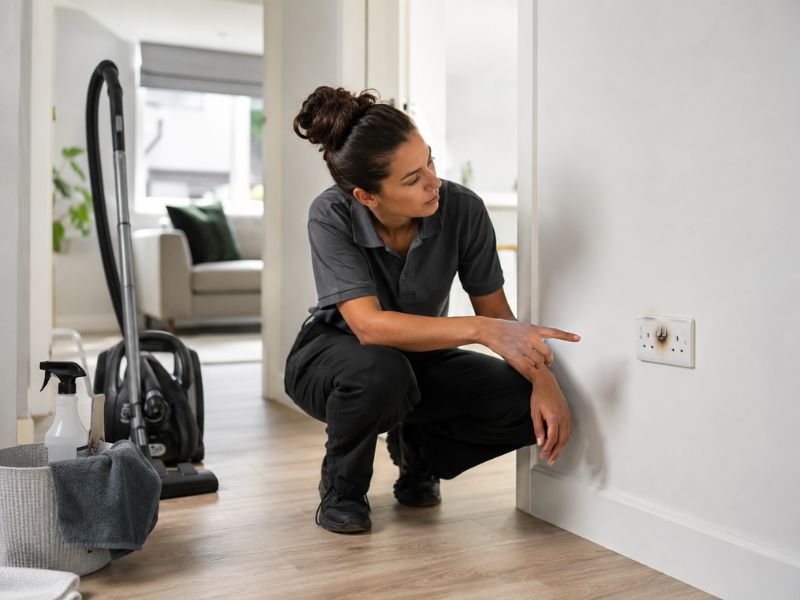
It is worth landlords understanding how an EICR is actually coded, because the classification determines the deadline. A C1 code means a danger is present and requires immediate remedial action, and the report is unsatisfactory. A C2 code means the installation is potentially dangerous and needs urgent remedial work, also making the report unsatisfactory. Under the 2020 regulations, C1 and C2 observations, along with an FI code meaning further investigation is required, must generally be put right within 28 days of the inspection, or sooner if the electrician specifies a shorter period. A C3 code is advisory only, an improvement recommendation, and does not on its own make a report unsatisfactory. A cleaner's role here is limited but genuinely useful: they may notice a damaged flex, a cracked plug, a scorch mark around a socket or an appliance that trips repeatedly. Assessing whether that constitutes a C1, C2 or C3 issue is a job for the qualified electrician who carries out the inspection, not for the cleaning team.
Landlords must ensure at least one smoke alarm is fitted on each storey of a property containing a room used as living accommodation, and a carbon monoxide alarm in any room used as living accommodation that contains a fixed combustion appliance, excluding gas cookers. Prescribed alarms must be checked and in proper working order on the day a new tenancy begins. A cleaner emptying and wiping down a property between tenants may be the person who notices an alarm hanging loose, missing its cover, or clearly disconnected, and flagging that before the new tenant moves in closes a gap that a landlord may not otherwise catch until the next scheduled check.
The Health and Safety Executive is clear that landlords have a duty to assess and control the risk of Legionella in their properties, under the Control of Substances Hazardous to Health Regulations 2002, with the detailed technical expectations set out in the HSE's Approved Code of Practice L8 and its supporting guidance. Most ordinary domestic systems present a low risk when water is used regularly, but a void period between tenancies is exactly the kind of gap where stagnation becomes a real concern. Practical controls include flushing the system through before letting, keeping hot water stored at 60°C or above and cold water below 20°C, and advising tenants to regularly clean and disinfect showerheads, since these aerosolise water and are a common point of exposure. For a property standing empty for an extended period, HSE guidance is that outlets on hot and cold systems should generally be used at least once a week to maintain flow and minimise the chance of stagnation, or that another suitable flushing regime should be adopted if that is not practical. None of this is a cleaning task in the formal sense, and a cleaner should not be assumed to be carrying out a Legionella risk assessment unless they are specifically contracted and competent to do so. But a cleaning visit during the void period is often the moment someone is physically in the property running taps and checking under sinks, which makes it a natural point to confirm the flushing regime has actually happened.
GOV.UK's Homes (Fitness for Human Habitation) Act 2018 guidance lists damp and mould growth, domestic hygiene, pests and refuse, food safety, sanitation and drainage, electrical hazards and fire safety among the relevant housing hazards a property must be free from to be considered fit to live in. This is a useful background for understanding why the individual points above are not treated as isolated maintenance items in law. They overlap, and a property that is genuinely well-maintained tends to score well across all of them at once. That said, the presence of a single cleanliness defect, a dusty extractor or a limescale-stained tap, does not on its own make a property legally unfit, and the article's central boundary applies here too: cleaners observe and report, they do not make legal or health-based habitability determinations.
Liverpool's selective licensing scheme was introduced in April 2022 and currently runs until March 2027, and the designated area covers around 80% of the city's private rental sector, meaning most privately let properties in the city need a licence unless specifically exempt. Liverpool City Council requires licence holders to inspect their properties every six calendar months and keep a written record, with additional inspections expected when tenants report disrepair. During those six-month inspections, council guidance says licence holders should conduct visual inspections of cleaning and cooking facilities to identify broken or rotten features that may be difficult to clean.
The point for a Liverpool landlord is not that cleaning is a licensing requirement in itself. It is that the city's rental sector already operates in an environment where documented inspection and property condition are a routine, recurring obligation for the large majority of landlords, so a systematic close clean at turnover fits naturally into a process many licence holders are already expected to be running.
It is worth landlords keeping these three categories distinct, because conflating them is one of the most common sources of deposit disputes. TDS guidance is that a tenant should generally return a property to the same standard of cleanliness recorded at check-in, with the check-in and check-out reports acting as the central evidence. A landlord cannot require a tenant to use a particular professional cleaning company, and the Tenant Fees Act framework restricts what can be charged as a condition of tenancy. Grease left in an oven is a cleaning issue. A broken cupboard hinge is damage. Ordinary deterioration from ordinary use, a worn carpet after several years, a faded patch of paint where furniture stood, may simply be fair wear and tear rather than either. A cleaner can document what they observe during the turnover. They do not determine deposit liability, and a professional clean does not guarantee a deposit will be returned in full, whatever the standard of the clean.
Most of what this article draws on is external evidence: government survey data, statutory guidance and sector statistics. That is useful, but it has a limit, because none of it is specific to what actually happens on a rental-property clean. Over time, the more valuable version of this article is one built on Scrubbed With Love's own job data rather than published statistics alone, tracking things like how often mould is found that was not visible on arrival, how often an extractor is heavily clogged, or how often a job gets reclassified from ordinary to specialist partway through. That is a longer-term project rather than something this article can claim today, and no percentage or frequency figure should be attached to Scrubbed With Love's own experience until it has actually been measured and confirmed by the team.
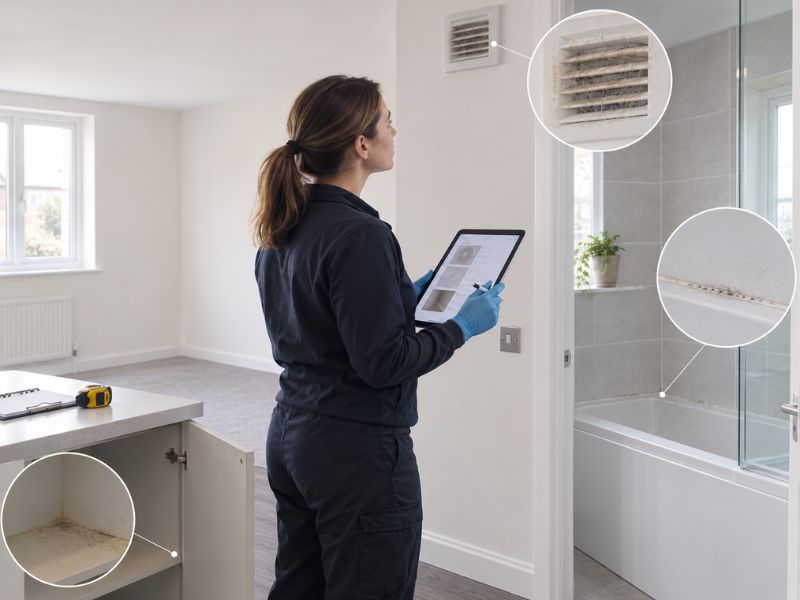
An empty property gives a landlord rare, uninterrupted access to areas that are normally obscured by furniture, belongings and daily life. Used properly, that access is worth more than a tidy handover. A practical sequence for the void period is straightforward: clean, observe, photograph and report, triage what has been flagged, repair or escalate to the right professional, document what was done, and then re-let. Professional cleaners can act as an additional set of trained eyes during that process, but they are not a substitute for a surveyor, an electrician, a plumber or a pest professional, and a good turnover clean should leave more than clean surfaces behind. It should leave the landlord with a clearer picture of the property's actual condition before the next tenant receives the keys.